
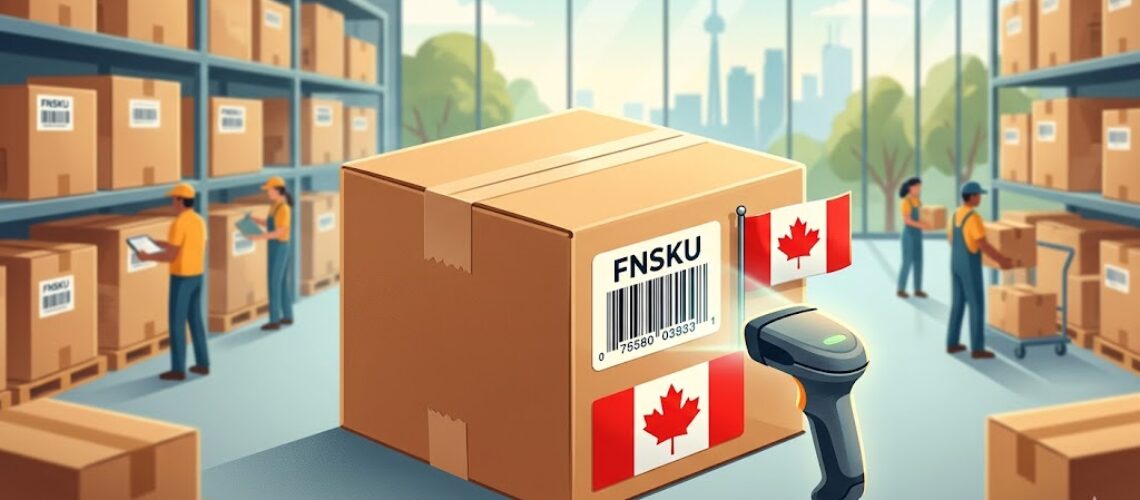
Key Takeaways: Learning how to choose an Amazon prep center in Canada comes down to five things: a documented error rate, a clear turnaround SLA, real-time shipment visibility, transparent per-unit pricing, and Canada-specific compliance knowledge. Amazon ended its in-house FBA prep on January 1, 2026, so every seller now needs an external prep partner that relabels, inspects, and routes inventory correctly into Amazon Canada.
If you sell on Amazon.ca and ship inventory into the FBA network, picking the wrong prep partner now costs more than it used to. Amazon discontinued its in-house FBA prep and item-labeling services, including FNSKU labeling, bagging, and bubble-wrapping, effective January 1, 2026 (Supply Chain Dive, 2025). That single policy change is why so many sellers are searching how to choose an Amazon prep center in Canada this year. The prep center is no longer optional infrastructure. It is the compliance layer that decides whether your units get accepted at the inbound dock or charged, returned, and delayed.
Most ranking guides on this topic are written for US sellers shipping into US fulfillment centers. This guide is different. It is built for sellers, international, Chinese cross-border, and Canadian, who inbound into Amazon Canada, where bilingual labeling rules and cross-border routing change the answer.
What should you look for when choosing an Amazon prep center in Canada?
The five non-negotiable criteria are a documented error rate, a written turnaround SLA, real-time shipment visibility, transparent pricing, and proven capacity. Third-party sellers accounted for 61% of Amazon unit sales in 2024 (Capital One Shopping, 2025), so prep volume is large, and a partner without measurable standards quietly leaks your margin.
Start with accuracy. A serious prep center tracks its own mislabel and miss-pack rate and will tell you the number. If a provider has never measured it, that is your answer. FNSKU errors do not just cost a relabel fee. They cause commingled inventory, rejected shipments, and listing suspensions while Amazon investigates.
Turnaround is next. Your SLA should state, in writing, how many business days from receiving to inbound shipment. A vague “we work fast” promise is unenforceable. Ask what the SLA becomes in Q4 peak season, because that is when slow prep kills your Buy Box.
Then visibility. A modern prep center gives you a client portal or warehouse management system where you see units received, prepped, and shipped, with photos. Spreadsheet-only tracking emailed once a day is a 2026 red flag, not a service.
Amazon ended its in-house FBA prep and item-labeling services, including FNSKU labeling, bagging, and bubble-wrapping, effective January 1, 2026 (Supply Chain Dive, 2025). Sellers shipping into Amazon Canada now depend entirely on an external prep center for compliant relabeling and inbound routing, which makes accuracy and visibility primary selection criteria.
For a full breakdown of what the inbound process covers, see our parent guide on what Amazon FBA prep in Canada involves.
Should you use a prep center, do FBA prep yourself, or rely on factory-direct prep?
A prep center wins for most growing sellers because it removes a recurring operational bottleneck without the fixed cost of your own facility. In our work with cross-border sellers, the breaking point is usually around a few hundred units per month, the volume where DIY prep starts eating the hours you should spend on sourcing and listings.
Doing prep yourself makes sense only at very low volume or when you need tight control over a fragile or regulated product. The hidden cost is your time, plus the learning curve on Amazon’s current inbound rules. One rejected shipment can erase a month of “savings.”
Factory-direct prep, asking your manufacturer to apply FNSKU labels and packaging before export, looks cheap and is tempting for Chinese cross-border sellers. The catch is verification. A factory will not catch a labeling error against Amazon Canada’s current standard, and you have no recourse from another country when units arrive non-compliant. There is also no inspection step between production and the fulfillment center.
The strongest setup for international and Chinese sellers is hybrid: let the factory handle bulk packaging, but route everything through a Canadian prep center for the final FNSKU relabel, an inspection pass, and the inbound shipment plan. That way prepped inventory enters Amazon Canada’s network, not the US network, and a Canadian set of eyes verifies compliance before the dock.
For the relabeling workflow specifically, see our guide on FNSKU relabeling in Canada.
How much does a prep center in Canada cost, and what hidden fees should you watch for?
Most Canadian prep centers price per unit, with relabeling and basic prep often in the low single-digit dollars per unit, but the published rate is rarely the full bill. The fees that surprise sellers are receiving charges, storage after a grace window, and per-shipment minimums. Always compare the all-in cost, not the headline number.
There are three common pricing models. Per-unit pricing charges for each prep action, simple, but watch the add-ons. All-inclusive bundles a fixed price per unit, predictable, but confirm what is excluded. À-la-carte itemizes every task; transparent if the menu is complete, dangerous if it is vague.
Watch these hidden fees specifically:
- Receiving fees charged per box or pallet on top of per-unit prep. A reasonable provider discloses this upfront.
- Storage creep. Prep is not storage. A prep center is not a warehouse or a 3PL, so inventory should flow through quickly. Long-stay storage fees signal a workflow that is too slow.
- Per-shipment or monthly minimums that punish smaller sellers.
- Disposal, return-handling, and exception fees buried in fine print.
Across the cross-border quotes we have reviewed, the providers that looked cheapest on the per-unit line were frequently the most expensive once receiving and minimum fees were added. The lesson: build a sample invoice for one realistic shipment and ask the prep center to confirm the total before you sign.
Amazon’s own pricing has moved too. Its FBA inbound placement service fee for standard-size products runs roughly $0.21 to $0.68 per unit in 2026 (Amazon Seller Central, 2026). That is an Amazon charge, separate from prep, but it belongs in your landed-cost math when comparing options.
How do prep centers handle FNSKU labeling and compliance now that Amazon ended its own prep?
Since January 1, 2026, the prep center is the only place FNSKU labeling reliably happens before inventory reaches Amazon Canada. Amazon discontinued FNSKU labeling, bagging, bubble-wrapping, and stickering as in-house services (Supply Chain Dive, 2025). A competent prep center has rebuilt its workflow around being that single point of compliance.
In practice, a good provider does four things on every unit. It applies the correct FNSKU so it fully covers any manufacturer UPC or EAN. It confirms the label is flat, unwrinkled, and machine-scannable. It applies category-correct packaging, poly bags with suffocation warnings, protective wrap for fragile goods. And it builds the inbound shipment plan so units route to the right Amazon Canada destination.
This matters more than before because Amazon has consolidated non-compliance penalties into its inbound defect fee structure. The platform has effectively raised the cost of bad prep: a mislabeled or wrongly packed unit is no longer a warning, it is a charge. A prep center that documents its error rate and pays for its own mistakes is protecting your margin directly.
With Amazon’s in-house FNSKU labeling and item prep discontinued effective January 1, 2026 (Supply Chain Dive, 2025), the external prep center is now the only compliance checkpoint between production and the Amazon Canada inbound dock. Its labeling accuracy directly determines whether shipments are accepted or charged.
See our detailed breakdown of FNSKU labeling requirements for 2026 in Canada and what Amazon Canada inbound prep actually requires.
What Canada-specific compliance should your prep center understand?
A Canadian prep center should understand bilingual labeling, the single biggest reason a US-based prep center is the wrong fit for Amazon Canada inventory. Canada’s Consumer Packaging and Labelling Act and the Safe Food for Canadians Regulations require most prepackaged consumer products to carry mandatory label information in both English and French (Competition Bureau Canada).
This is the heart of the Canada wedge. A US prep center labels for the US market and has no reason to flag a product whose packaging is English-only. A Canadian prep center should catch it before the unit ships, because non-compliant packaging in the Canadian market is a regulatory problem, not just an Amazon problem. When you compare providers, ask directly whether they review products against bilingual requirements.
Cross-border routing is the second Canada-specific factor competitors ignore entirely. For international and Chinese sellers importing into Canada, the prep center sits at a customs handoff. It should be able to receive cross-border freight, consolidate shipments before prep, and accept the customs documentation cleanly so units are not stranded. Then it routes prepped inventory into Amazon Canada’s inbound network, not the US network, which is a routing mistake that quietly costs sellers weeks.
Lead times follow from this. Once units are prepped, your prep center builds the Amazon Canada shipment plan, books carriage, and inbounds to the assigned destination. A Canada-based workflow shortens that path. We cover the timing in detail in our article on how a Canada-based prep workflow reduces delay and FBA rework.
What are the warning signs of a fake or unreliable prep center?
The clearest warning sign is a provider that cannot tell you its error rate or refuses to pay for its own mistakes. After Amazon ended in-house prep on January 1, 2026 (Supply Chain Dive, 2025), demand for prep surged, and a wave of underqualified operators followed. Knowing the red flags is half of how to choose an Amazon prep center in Canada.
Walk away if you see these:
- Spreadsheet-only tracking. No client portal or WMS means you cannot independently verify what was received or shipped. Photos and a live count should be standard.
- No documented error rate. “We rarely make mistakes” is not a metric. A real provider measures and shares it.
- No insurance. If inventory is damaged or lost while in their hands, you need coverage, not an apology.
- Refusal to own mistakes. A prep center that will not credit you for a relabel it botched is telling you who pays for the next error.
- Vague pricing with surprise receiving fees. If they will not produce a sample invoice for one shipment, the surprises start after you sign.
- “Warehouse” or “overseas warehouse” positioning. A prep center preps and ships fast. A provider that pushes long-term storage is solving the wrong problem.
The pattern we see most often is the provider that wins on price, then reveals a per-box receiving fee and a monthly minimum once volume starts. Transparent providers hand you the full cost before the first unit arrives. Want a faster vetting checklist? Ask each candidate the six questions below.
What questions should you ask a prep center before you sign?
Ask six questions, and the answers will separate a real partner from a risky one. These cover the gaps that pricing pages hide: accountability, capacity, compliance, and routing. Run them against every shortlisted provider.
- What is your documented error rate, and how do you measure it? A number, and a method, signal real quality control.
- What is your turnaround SLA, in business days, and how does it change in Q4? Get it in writing.
- Do I get a client portal with real-time counts and photos? Visibility is a baseline, not an upgrade.
- What is the complete fee list, including receiving, storage, and minimums? Ask for a sample invoice on one realistic shipment.
- Do you review products for bilingual English and French labeling compliance? This confirms genuine Canadian capability.
- Who pays when you make a mistake, and are you insured? The answer reveals how the relationship handles its first error.
A prep center confident in its operation answers all six without hedging. Hesitation on any single one is a useful signal.
Frequently Asked Questions
Do I need a prep center now that I sell on Amazon Canada?
For most FBA sellers, yes. Amazon discontinued its in-house FBA prep and item-labeling services effective January 1, 2026 (Supply Chain Dive, 2025). Unless you prep accurately yourself, an external prep center is now the compliance checkpoint that keeps your inventory from being rejected or charged at the inbound dock.
Is a prep center the same as a warehouse or a 3PL?
No. A prep center prepares inventory, FNSKU relabeling, inspection, packaging, and inbound shipment plans, then ships it onward quickly. A warehouse or 3PL focuses on long-term storage and order fulfillment. Inventory should flow through a prep center fast, so persistent storage fees are a sign of a slow or misaligned workflow.
Can a US prep center handle my Amazon Canada inventory?
It usually should not. US prep centers route into the US fulfillment network and label for the US market. Canada requires bilingual English and French label information under the Consumer Packaging and Labelling Act (Competition Bureau Canada). A Canadian prep center routes into Amazon Canada and catches bilingual compliance gaps a US provider would miss.
How much should FBA prep in Canada cost per unit?
Basic relabeling and prep are often in the low single-digit dollars per unit, but the all-in cost matters more than the headline rate. Add receiving fees, storage, and minimums before comparing. Also budget Amazon’s separate inbound placement service fee, roughly $0.21 to $0.68 per unit for standard-size items (Amazon Seller Central, 2026).
What is the biggest red flag when choosing a prep center?
A provider that cannot state its error rate or refuses to pay for its own mistakes. Spreadsheet-only tracking, no insurance, and vague pricing with surprise receiving fees are close behind. Any one of these means you carry the cost of every error, which erodes the margin a prep center is supposed to protect.
Conclusion: choose the prep center that protects your margin
Knowing how to choose an Amazon prep center in Canada is now a core seller skill, not a side decision. Amazon ended its in-house FBA prep on January 1, 2026, and the prep center became your single compliance checkpoint into Amazon Canada. Prioritize a documented error rate, a written SLA, real-time visibility, transparent all-in pricing, and genuine Canadian compliance knowledge, especially bilingual labeling and cross-border routing. Avoid providers that hide fees, skip insurance, or refuse to own their mistakes.
For sellers shipping cross-border into Canada, the ZH companion guide, how to choose a prep center for Chinese sellers, covers the same decision in Chinese.
Ready to compare against a Canada-native prep partner? Review our Amazon prep center service in Canada and request a transparent, all-in quote before your next inbound shipment.