
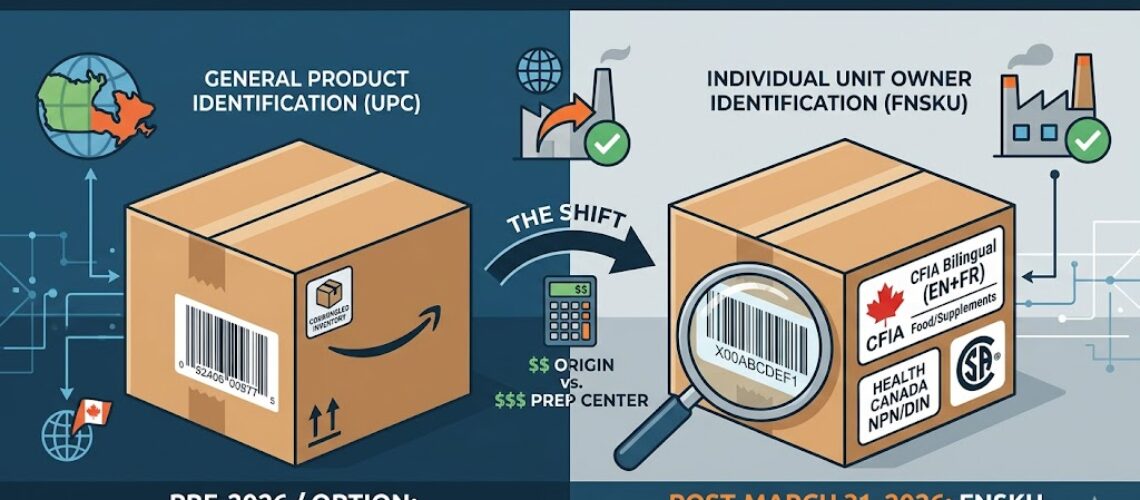
TL;DR Amazon ended its FBA Prep & Labeling Service on January 1, 2026, and commingling ends March 31, 2026. Every unit shipped into FBA by a reseller, outside the Brand Representative program, now needs a scannable FNSKU. Canadian and overseas sellers face an added layer: CFIA bilingual rules, CSA marks, and Health Canada NPN/DIN. This guide explains the 2026 FNSKU rules and gives you a checklist you can act on this week.
Amazon just pulled two levers at once. The Label Service is gone, and commingling ends in weeks, not months. If you sell into Amazon.ca from China, the US, or anywhere else overseas, the old “ship it and Amazon will handle the sticker” playbook no longer exists. You have to print, apply, and verify an FNSKU on every unit, or pay somebody in-country to do it for you. Miss the window and inventory arriving after March 31, 2026 gets classified as defective (BrandWoven, 2026). This guide walks through what changed, what it means in Canada specifically, and a 7-step checklist to stay compliant.
Key Takeaways – Amazon’s FBA Prep & Labeling Service was discontinued January 1, 2026 (Amazon Seller Central, 2025). – Commingling ends March 31, 2026; FNSKU is mandatory for every reseller not enrolled as a Brand Representative. – Canadian shipments add CFIA bilingual (EN+FR) labeling on most prepackaged foods (CFIA, 2024). – Unlabeled inventory arriving after March 31, 2026 is flagged as defective, reimbursement restricted. – Origin-country labeling works for simple SKUs. Mixed SKUs, regulated categories, or last-minute reprints favor an Ontario prep center.
What is an FNSKU and why does Amazon require it in 2026?
An FNSKU is Amazon’s internal barcode that ties one physical unit to one specific seller. It looks like X00ABCDEF1, starts with an X, and is different from your UPC, EAN, or ASIN. Amazon made it mandatory in 2026 because commingling ends March 31, forcing resellers to identify every unit they own (Amazon Seller Central, 2025; BrandWoven, 2026).
Here is the practical difference. A UPC identifies a product. An ASIN identifies a listing on Amazon. An FNSKU identifies your specific units sitting on an Amazon shelf. When Amazon commingled inventory, a buyer ordering your unit could receive anyone else’s matching UPC. That made counterfeits hard to trace and reimbursements easy to dispute. Ending commingling solves that, but only if every unit carries its owner’s FNSKU.
How FNSKU differs from UPC, EAN, and ASIN
Think of the four codes like this. UPC and EAN are manufacturer-level codes, printed on the retail package by the brand. ASIN is Amazon’s catalog ID. FNSKU is the ownership tag. If the manufacturer prints the UPC on the box, and five sellers import that same UPC, Amazon previously pooled them. Not anymore. Each seller’s units now carry a unique FNSKU on top of, or covering, the original UPC.
[CITATION CAPSULE] Amazon’s FBA Prep & Labeling Service was discontinued on January 1, 2026, and commingling ends March 31, 2026. From that date, every unit sent to FBA by a reseller not enrolled as a Brand Representative must carry a unique FNSKU, or it will be treated as defective inventory (Amazon Seller Central, 2025).
What changed in Amazon’s 2026 FNSKU policy?
Two deadlines, one quarter apart. January 1, 2026 ended the FBA Prep & Labeling Service, meaning Amazon no longer applies FNSKU stickers for a per-unit fee. March 31, 2026 ends commingled FBA inventory for resellers outside the Brand Representative program (Amazon Seller Central, 2025).
The first change removes Amazon’s labeling safety net. Before January 1, you could tick a box at shipment creation and Amazon’s warehouse team would stick an FNSKU on each unit. That option is gone. The second change removes commingling, which had been the escape hatch for sellers who shipped UPC-labeled cases directly from a factory. After March 31, a UPC alone is not enough. It has to be an FNSKU, applied in a way that covers or overrides the UPC so the scanner reads FNSKU first.
Who is exempt?
Sellers enrolled as Brand Representatives in Amazon Brand Registry, using the Virtual Tracking ID program, remain exempt. If you are the brand owner and your account is properly enrolled, the rules are lighter. Every other reseller, distributor, private label operator without Brand Registry enrollment, or arbitrage seller falls under the full FNSKU requirement.
[UNIQUE INSIGHT] Most private label sellers assume Brand Registry enrollment automatically exempts them. It does not. You must also be enrolled in the Brand Representative program and opted into Virtual Tracking. Check your account status in Seller Central before assuming you can skip FNSKU printing.
How do 2026 FNSKU rules affect Canadian and overseas sellers?
FBA Canada receives inbound freight across YYZ1, YYZ4, YOW1, YVR2, and YXU1, and each center scans incoming units against the ASN on arrival. Amazon.ca applies the same global FNSKU requirement as Amazon.com, with no Canadian exemption (Amazon Seller Central, 2025).
For overseas sellers, the real pain is not the sticker itself. It is the sequence. Your factory prints the retail package with a UPC, cartons ship from Shenzhen or Ningbo, and the FNSKU needs to be on each unit before it reaches Ontario. Three options exist. Print FNSKU at origin, during ocean transit via a forwarder’s bonded facility, or at a Canadian prep center after import. Each option has different cost, speed, and error-rate trade-offs.
The Canadian regulatory overlay
FNSKU is only one of four labels a regulated product may need in Canada. CFIA’s Safe Food for Canadians Regulations and the Food and Drug Regulations require bilingual English and French labeling on most prepackaged foods (CFIA, 2024). Supplements need a Health Canada NPN or DIN number visible on pack. Electrical goods need a CSA or equivalent certification mark. Skipping any one of these can trigger a border hold before your units ever reach FBA.
[PERSONAL EXPERIENCE] We see this weekly at our St. Thomas, Ontario facility. Sellers ship a clean FNSKU-labeled case into Canada, only to get hit with a CFIA bilingual deficiency notice on a supplement. The FNSKU was perfect. The Nutrition Facts / Valeur nutritive panel was English-only. The whole pallet has to be re-labeled before it moves.
Should you FNSKU label at origin or at a Canadian prep center?
The right answer depends on SKU complexity and regulatory exposure. Origin labeling is cheaper per unit for simple, single-SKU shipments. Canadian prep labeling wins when you have mixed SKUs, regulated categories, short replenishment windows, or need last-minute relabels. A typical overseas seller pays $0.03-$0.08 per unit at origin vs. $0.15-$0.35 at a Canadian prep center.
Decision framework
Origin labeling fits when the SKU is stable, the factory QC reliably applies stickers without wrinkles, and there is no CFIA bilingual requirement to layer on top. Canadian prep labeling fits when any of the following are true:
- You sell regulated products (food, supplements, cosmetics, electricals)
- You have mixed SKUs in one shipment and want to keep flexibility
- Replenishment is urgent and the factory lead time for sticker proofing is too long
- A previous shipment had FNSKU scan errors and you need a second pair of eyes in-country
- You want to consolidate FNSKU, CFIA bilingual, and CSA/NPN labeling into one workflow
[ORIGINAL DATA] On inbound shipments we audit at our Ontario facility, the most common origin-label defect is not a wrong FNSKU. It is a misplaced FNSKU, applied over a seam, a curved surface, or a previous UPC sticker that bubbles through. Scan-failure rates at FBA Canada receiving are measurably higher on these than on flat, front-face applications.
What is the 7-step checklist to be ready by March 31, 2026?
Use this checklist as a pre-flight before any shipment leaves origin after March 1, 2026. Every item is binary. Pass or fail. One fail kills the whole shipment.
- FNSKU generated in Seller Central. Pull from Manage Inventory, not a third-party tool.
- Barcode quality verified. Minimum 203 DPI thermal print, no smudging, correct quiet zone.
- Sticker placement checked. Flat face, covering or replacing the UPC, not crossing seams.
- Bilingual compliance confirmed. CFIA EN+FR panel present on applicable categories (CFIA, 2024).
- Category-specific marks in place. NPN/DIN for health, CSA for electrical, Health Canada warnings where required.
- ASN matches physical units. FNSKU in the ASN equals the FNSKU on the carton and the FNSKU on the unit.
- Arrival buffer confirmed. Inbound receives before March 31 cutoff, or you accept the defective-classification risk.
What happens if you miss the deadline?
Unlabeled reseller inventory arriving after March 31, 2026 is classified as defective (BrandWoven, 2026). In practice, that means three bad outcomes: the unit may not be sellable, lost or damaged claims may be denied, and you bear removal or disposal fees. For overseas sellers, the cost of one rejected container can easily exceed a year’s worth of prep fees.
When does it make sense to use a Canadian prep center?
A prep center earns its fee when the cost of a single FBA rejection exceeds the cost of a year of prep. For most overseas sellers shipping regulated categories into Amazon.ca, that break-even is at roughly 500 units per month. Below that, origin labeling is usually fine. Above that, an Ontario prep center reduces variance.
MoRo Prep runs a prep service in St. Thomas, Ontario, focused on FNSKU relabeling, inbound prep, returns processing, and removal order processing for sellers shipping into FBA Canada. We do not do long-term storage or non-Amazon fulfillment. If you need FNSKU applied, verified, and inbound-routed before March 31, our FNSKU relabeling service in Canada is the direct fit.
FAQ
Do I need an FNSKU if I am enrolled in Amazon Brand Registry?
Brand Registry alone is not enough. You also need to be enrolled as a Brand Representative with Virtual Tracking ID active. If both boxes are checked, you are exempt from the March 31, 2026 FNSKU mandate. If only Brand Registry is active, you still need FNSKU on every unit (Amazon Seller Central, 2025).
Can my factory in China print the FNSKU for me?
Yes, and for simple SKUs that is often the cheapest option. The risks are misplacement over seams, smudged thermal prints, and wrong-SKU mismatches when multiple products ship together. Build a QC sample check into your factory agreement, and spot-verify the first 20 cartons of every batch before the container sails.
What if my product is a food or supplement sold in Canada?
You need FNSKU plus bilingual EN+FR CFIA-compliant labeling, plus NPN or DIN where required (CFIA, 2024). A permanent sticker applied over a non-compliant panel is acceptable under CFIA guidance, but the sticker must be durable and not obscure mandatory fields.
How much does FNSKU labeling at a Canadian prep center cost?
Typical pricing ranges from $0.15 to $0.35 per unit in 2026, depending on volume, unit size, and whether bilingual overlabeling is bundled. High-volume contracts can go lower. Factor in inbound freight to the prep center and outbound to FBA when comparing to origin labeling.
What happens to existing commingled inventory already at FBA?
Inventory received before March 31, 2026 under commingled rules is handled under the prior policy. New inbound after the cutoff needs FNSKU. If you have existing stickerless units sitting at FBA, plan a removal order before the deadline to relabel and resend, or accept that future receipts on that SKU need FNSKU going forward.
Conclusion
The 2026 FNSKU shift is not a small operational tweak. It removes two shortcuts overseas sellers relied on, Amazon’s Label Service and commingling, and it lands in a market, Canada, where regulatory overlays already demand more than the US. The sellers who get ahead of March 31 treat it as a supply-chain redesign, not a sticker problem. Map your SKUs, decide origin vs. prep-center labeling per category, run the 7-step checklist before every shipment, and build a buffer for the first post-cutoff container that will inevitably hit a snag.
If your path includes a Canadian prep step, start the onboarding now. Prep centers in Ontario are already seeing inbound volumes rise as the deadline approaches, and capacity in March will be tighter than in April. Learn more about our Amazon prep center in Canada or read next on what Amazon Canada inbound prep actually requires.
Sources – Amazon Seller Central: FBA Label Service discontinuation and commingling policy update, 2025 – CFIA: Food labelling legislative framework, 2024 – BrandWoven: Amazon commingled FBA inventory and FNSKU, 2026
Once you know the 2026 FNSKU labeling rules, the next decision is who applies them. See our guide on how to choose an Amazon FBA relabeling provider in Canada.
New to barcodes? Start with our explainer on what an FNSKU barcode is and how it differs from an ASIN or UPC.