
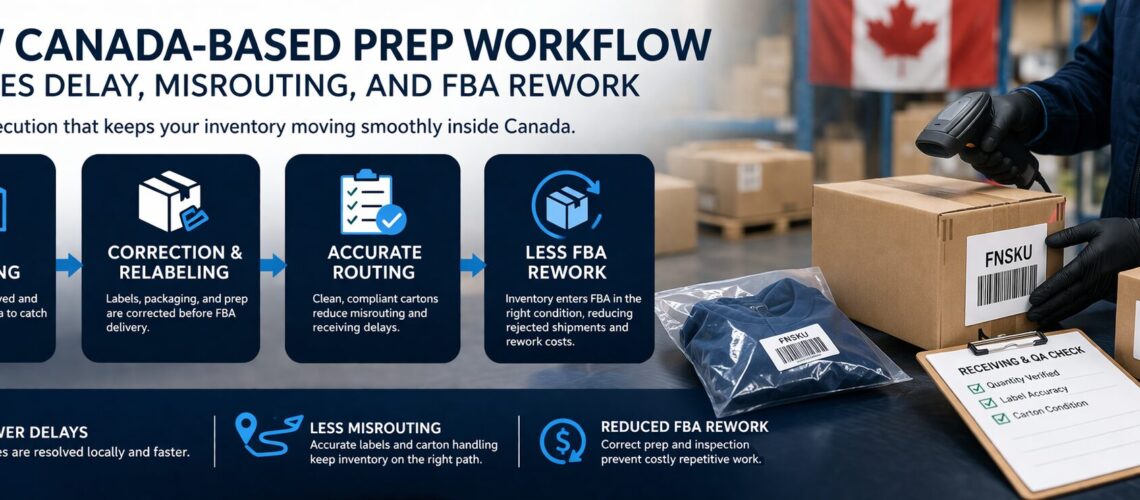
TL;DR: Overseas Amazon sellers shipping to Canada’s FBA network face delays and rework when inventory issues can only be resolved locally. A Canada-based prep centre — handling receiving, inspection, FNSKU relabeling, and repackaging — provides a physical correction point before inventory reaches Amazon, eliminating the root cause of most misrouting and rework incidents.
For overseas sellers, inventory delays do not always begin at the fulfillment center.
In many cases, the real problem starts earlier — when inventory arrives in Canada without a reliable local workflow for receiving, correction, relabeling, and recovery handling.
That is why a Canada-based prep workflow matters.
It does more than prepare inventory for FBA. It helps reduce the operational problems that create lost time, misrouting, and expensive rework later.
Delay Is Usually Not Just a Shipping Problem
When overseas sellers think about delay, they often think about customs, freight transit, or carrier speed.
But in actual Amazon operations, delay often comes from something else:
- labels that need correction
- cartons that do not match the shipment plan
- inventory that needs local inspection before moving forward
- returned or mixed inventory that cannot go straight back into FBA
- removal stock that needs sorting, repacking, or relabeling before recovery
In other words, delay is often not caused by distance alone.
It is caused by the absence of a Canada-side workflow that can handle inventory once exceptions appear.
Why Misrouting and Rework Happen
Misrouting and FBA rework usually do not come from one dramatic mistake.
They come from small execution gaps that are not caught early enough.
Inconsistent Labeling
If carton labels, FNSKU labels, or shipment identifiers are inconsistent, inventory may not move cleanly through the next stage. That increases the chance of receiving delays, confusion, or rerouting.
No Local Correction Point
When inventory arrives in Canada and needs intervention, sellers without local support often have no practical correction point. That means small issues become larger workflow problems.
Mixed or Returned Inventory
Returned units, mixed inventory, or partially processed stock often require local checking before re-entry. Without that step, sellers increase the chance of sending the wrong inventory back into FBA.
Removal Inventory With No Structured Workflow
When removal orders are received, inventory still needs a path: inspect, sort, recover, relabel, repack, or dispose. Without a structured local workflow, recovery becomes slower and more expensive.
What a Canada-Based Prep Workflow Actually Does
A Canada-based prep workflow gives sellers a local execution layer before issues become expensive.
That usually includes:
- receiving inbound inventory in Canada
- checking carton condition and shipment accuracy
- relabeling units or cartons when needed
- correcting prep issues before FBA delivery
- staging inventory that cannot move forward immediately
- inspecting returned inventory before re-entry
- handling removal stock for recovery or next-step decisions
This changes the workflow in a very practical way.
Instead of reacting after inventory fails, sellers have a local process that can catch, correct, and route inventory before the problem grows.
How This Reduces Delay
The first advantage is time control.
A local workflow helps reduce delay because correction happens closer to the problem.
Instead of discovering issues only after inventory is refused or delayed deeper in the process, sellers can resolve many of them through local receiving, relabeling, and pre-FBA checks.
That does not eliminate every delay.
But it reduces the delays caused by avoidable execution gaps.
How This Reduces Misrouting
Misrouting often happens when inventory is not clearly controlled at the carton and workflow level.
A Canada-based prep workflow improves this by creating a local checkpoint for:
- shipment matching
- label verification
- carton handling consistency
- routing decisions before FBA intake
That makes inventory movement cleaner and easier to control.
How This Reduces FBA Rework
FBA rework becomes expensive when inventory has already moved too far into the wrong path.
A local workflow reduces rework by creating a place where inventory can be checked and corrected before another failed entry attempt happens.
This is especially important for:
- returned inventory
- relabeling cases
- mixed inventory
- removal stock intended for recovery
- inventory that needs repacking before re-entry
Without local workflow control, rework often becomes repeated rework.
With local workflow control, correction becomes a defined step rather than an ongoing reaction.
Why This Matters for Overseas Sellers
For sellers operating from overseas, Canada is not just a destination market.
It is an execution environment.
That means the question is not only whether inventory can reach Canada.
The question is whether inventory can keep moving once something needs to be corrected, reclassified, or recovered inside Canada.
A Canada-based prep workflow gives sellers a better answer to that question.
It provides a local operating path for inventory that does not move perfectly on the first attempt.
For sellers looking for a more detailed breakdown of what Amazon Canada inbound prep actually requires — including what “local execution” means in practice — see What Amazon Canada Inbound Prep Actually Requires for Overseas Sellers. If your prep timeline is being compressed by a potential Prime Day date shift, see Prime Day May Move to June: Canada Prep Services for Amazon Sellers.
Related Seller Services
A Canada-based workflow usually connects several operational services together.
Related seller services include:
- Amazon Prep Center Canada
- Amazon Removal Order Processing Canada
See how our Canada-based prep workflow supports Amazon operations in Canada.
See how removal inventory can be processed locally when recovery is needed:
[Insert Amazon Removal Order Processing Canada page link here]
You can also visit our homepage to learn more about MoRo Prep’s Canada-side execution support.
The Four Most Common FBA Inbound Failures
Misrouting. Inventory shipped directly to the wrong fulfillment center is one of the most expensive mistakes an overseas seller can make. Amazon assigns FC destinations dynamically at the time a shipment plan is created, and those assignments can change between planning and shipping. If a seller hard-codes a destination address based on a previous shipment or an outdated plan, Amazon rejects the inbound at intake and charges a misroute fee of $1.50–$3.00 per unit. On a 300-unit shipment, that’s a $450–$900 penalty before a single unit reaches a shelf.
Label Errors. FNSKU barcodes that are partially obscured, wrinkled, printed at the wrong size, or placed over a manufacturer barcode are a persistent source of intake failures. Amazon’s scan systems at the fulfillment center require a clean, unobstructed read on the first pass. When a scan fails, the unit is pulled into a manual processing hold that typically runs 7–14 days, and Amazon may issue a non-compliance fee on top of the delay. For sellers running tight restock cycles, two weeks of frozen inventory can mean stockouts and ranking drops.
Prep Mismatches. Amazon’s prep requirements vary by ASIN category, product type, and sometimes individual listing. Units that require poly-bagging, bubble-wrap, or suffocation warning labels must arrive with that prep already completed. When they don’t, Amazon assesses a prep non-compliance fee and places the entire shipment on hold pending corrective action. The cost isn’t just the fee — it’s the time the inventory sits unusable while the issue is resolved, often requiring coordination across time zones for an overseas seller who has no one local to intervene.
Quantity Discrepancies. When a shipment is declared at 200 units but only 194 are received at the fulfillment center, Amazon opens a reconciliation investigation. These investigations are not fast. Inventory can remain frozen for 30–45 days while Amazon works through its internal process. For a seller who has already paid for that inventory and factored it into their restocking plan, a six-week reconciliation window creates a compounding cash flow problem that a simple recount before shipping could have prevented entirely.
How a Local Prep Center Eliminates Each Failure Point
MoRo Prep, based in St. Thomas, Ontario, is positioned specifically to close these gaps for sellers who cannot manage Canadian FBA logistics from overseas. On routing, MoRo Prep creates the FBA inbound shipment plan after inventory has already been received at the prep facility — which means FC assignments are always current and accurate at the time the shipment is built. There is no lag between plan creation and physical shipping.
On labeling, MoRo Prep prints FNSKU labels directly from Seller Central PDFs and scans every unit individually before it goes into a carton. There is no guesswork about barcode placement, no reprinting from memory, and no risk of a manufacturer barcode showing through. On prep requirements, MoRo Prep verifies the prep specification per ASIN before any processing begins — poly-bagging, bubble wrap, and suffocation warnings are applied to the correct units in the correct configuration. On quantity, MoRo Prep performs a full unit count on receipt and again on outbound, with photo documentation at both checkpoints. If there is a discrepancy, it is caught before Amazon ever sees the shipment.
What Overseas Sellers Save
The financial case for using a local prep center is straightforward when the numbers are laid out. Avoiding a single misroute event on a 300-unit shipment saves approximately $450 in direct fees alone. Eliminating one inventory hold per quarter frees 3–5 weeks of active selling time. For a SKU generating $4,000 per month in revenue, that recovered selling window represents $3,000–$5,000 per incident. Prep center fees for 300 units typically run $150–$200 in total. The ROI on a single prevented incident is 15–25 times the cost of the service.
For sellers managing multiple SKUs, running seasonal restocks, or scaling into new product lines, the math compounds quickly. A standing relationship with a Canadian prep center is not an overhead expense — it is the most cost-effective insurance policy available in the FBA supply chain, and one of the few that pays back in the same quarter it is purchased.