
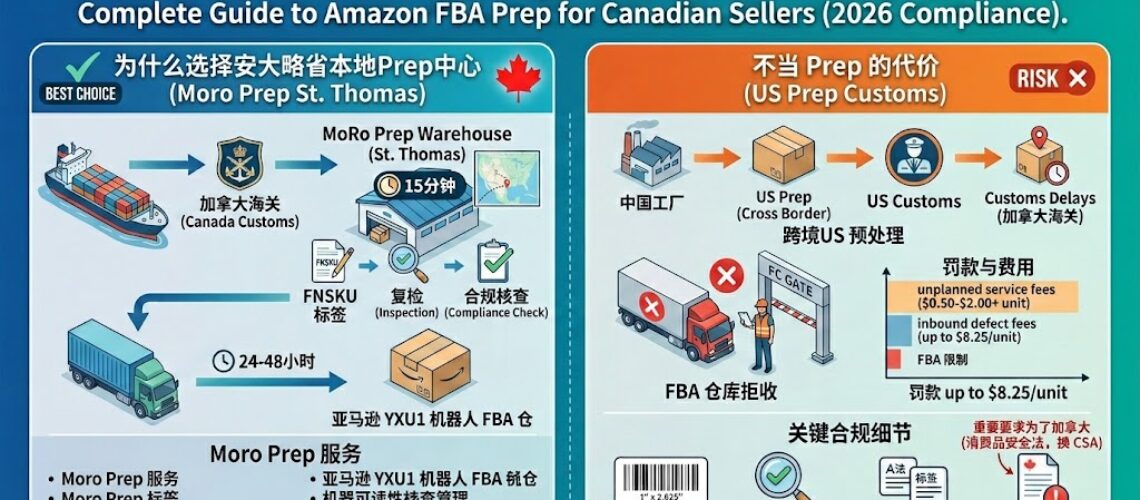
TL;DR: Amazon FBA prep is the process of preparing your products to Amazon’s inbound standards before they enter a fulfillment center — including FNSKU labeling, poly bagging, bundling, and shipment routing. In Canada, using a local prep center in Ontario helps overseas sellers reduce customs delays, rejected shipments, and escalating inbound defect fees that now reach up to $1.74 per unit.
If you sell on Amazon.ca and ship your products directly into Amazon’s fulfillment network, FBA prep is not optional — it’s the compliance layer that determines whether your inventory gets accepted or rejected at the door.
This guide explains what Amazon FBA prep is, what it includes, how it works for overseas sellers shipping into Canada, and why the decision of where you do your prep matters more than ever in 2026.
What Does “Amazon FBA Prep” Actually Mean?
FBA stands for Fulfillment by Amazon. When you use FBA, you send your inventory to Amazon’s warehouses and Amazon handles storage, packing, and shipping to your customers.
FBA prep — short for preparation — is everything that needs to happen to your products before they arrive at the fulfillment center. Amazon has strict inbound requirements, and if your products don’t meet those standards, Amazon will either:
- Charge you unplanned service fees ($0.50–$2.00+ per unit), or
- Reject the shipment entirely and send it back at your expense
Since Amazon discontinued its internal FBA Prep Services for most shipments on January 1, 2026 (Pattern, 2026; BrandWoven, 2026), sellers are now fully responsible for ensuring their inventory meets compliance standards before it enters the warehouse.
What Does FBA Prep Include?
FBA prep is not a single task — it’s a checklist of requirements that vary by product type, category, and shipment method. Here are the core components every Canadian FBA seller needs to understand:
How Does FNSKU Labeling Work?
FNSKU stands for Fulfillment Network Stock Keeping Unit. It’s Amazon’s internal barcode that ties each unit to your specific seller account — preventing your inventory from being mixed with another seller’s products.
Every product entering an Amazon Canada fulfillment center must have an FNSKU barcode that:
- Is correctly sized (standard: 1″ × 2.625″)
- Fully covers any manufacturer barcode (UPC/EAN)
- Is placed flat on the product surface with no wrinkles or obstructions
- Is machine-readable by Amazon’s automated scanning systems
Because Amazon Canada inbound workflows rely heavily on automated scanning, FNSKU accuracy requirements have become more stringent. A misplaced or partially obstructed label that looks acceptable by eye can still create receiving or compliance problems.
What Packaging Requirements Apply?
Beyond labeling, Amazon requires specific protective packaging depending on product category:
- Poly bagging: Required for soft goods, apparel, fabric items, and products susceptible to dust or moisture contamination
- Bubble wrap / foam padding: Required for fragile or breakable items
- Suffocation warnings: Required on poly bags with openings larger than 5 inches
- Set labeling: Multi-unit sets must be clearly marked “Sold as Set — Do Not Separate”
- Expiration dates: Perishable or consumable products must display expiration dates in a specific format and placement
How Do Shipment Routing Requirements Work?
When you create an FBA shipment in Seller Central, Amazon’s inbound placement service assigns your inventory to specific fulfillment centers. Your boxes must be:
- Packed according to the assigned FC destination
- Labeled with the correct Box Labels and FBA shipment labels
- Sealed and weight-compliant (standard carton: max 50 lbs, max 25″ on any side)
Routing errors — sending inventory to the wrong FC or using outdated shipment labels — now trigger inbound defect fees that, based on 2026 industry reporting, range from roughly $0.32 to $1.74 per standard-size unit and up to approximately $8.25 per oversize unit. Check the current fee schedule in Seller Central before costing out a shipment. These fees can quickly erode margins on cost-sensitive products.
Why Is FBA Prep Especially Important for Overseas Sellers Shipping into Canada?
Overseas sellers shipping into Canada face a specific set of challenges that sellers shipping within the US do not.
The Cross-Border Problem
Many overseas sellers — including a significant portion of China-based sellers on Amazon.ca — route their inventory through US prep centers before shipping to Canada. This approach creates two customs clearances, additional transit time, and US-to-Canada trucking costs that add up quickly.
A shipment routed through a US facility must clear US Customs on import, complete prep, then cross into Canada, clear Canadian Customs again, and finally travel to the Amazon Canada fulfillment center. Each step adds time and potential delay.
Local Ontario Prep Quality Matters
For sellers shipping inventory into Ontario, prep quality is not just a warehouse-location question. Amazon inbound workflows rely on labels, packaging, carton information, and scan accuracy being correct before units arrive at fulfillment.
A Canada-based prep workflow helps overseas sellers reduce rework risk by checking FNSKU labels, packaging, and shipment readiness before inventory enters the Amazon FBA network.
Amazon Discontinued Its Own Prep Service in 2026
Until the end of 2025, sellers could opt to have Amazon perform prep work on arrival (labeling, poly bagging) for a fee. Amazon ended this service on January 1, 2026. Sellers who relied on Amazon to catch and fix prep errors no longer have that safety net.
This means every shipment must arrive already correctly prepped — or face fees that were not part of the original cost model.
What Does a Canadian FBA Prep Center Do?
An FBA prep center in Canada is a service business that receives your inventory, performs all required prep, and ships the prepped goods to Amazon’s fulfillment center. Here’s what a full-service prep center handles:
| Service | What It Means |
|---|---|
| FNSKU relabeling | Printing and applying the correct Amazon barcode to each unit |
| Poly bagging | Bagging soft or dust-sensitive items in compliant packaging |
| Bundling | Combining multiple units into a sell-as-set package |
| Inspection | Checking for visible damage, defects, or incorrect items |
| Removal order processing | Receiving inventory returned from Amazon and relabeling for re-entry |
| Returns processing | Inspecting customer returns and determining restock eligibility |
| FBA shipment creation | Creating the inbound shipment in Seller Central and routing to the correct FC |
How Does FBA Prep Pricing Work?
Prep center pricing varies by service and volume. Typical Canada-based rates:
- FNSKU labeling: $0.10–$0.20 per unit
- Poly bagging: $0.25–$0.50 per unit
- Full prep (label + bag + box): $0.50–$1.50 per unit
- Inspection only: $0.10–$0.25 per unit
These costs should be weighed against Amazon’s unplanned service fees ($0.50–$2.00+ per unit) and inbound defect fees (up to $8.25 per unit) that apply when inventory arrives out of compliance.
For most sellers, using a prep center is not just a logistics choice — it’s a cost management decision.
Why Should Overseas Sellers Use a Local Ontario Prep Center?
For sellers shipping from China or other international origins into Amazon Canada, there are three strong reasons to use a prep center physically located in Ontario:
1. Single Customs Clearance
Inventory shipped directly from overseas to a Canadian prep center goes through Canadian customs once. A prep center in Ontario can receive the goods, complete all prep, and ship directly into the Amazon Canada fulfillment network without touching the US at all.
2. Faster Ontario-to-Amazon Transit
MoRo Prep’s prep center in St. Thomas, Ontario supports a shorter local handoff after prep is complete. The operational advantage is not the facility name itself, but reducing avoidable transit, relabeling, and restocking delays for Amazon Canada inventory.
3. Local Handling for Removals and Returns
When Amazon issues a removal order — sending inventory back out of the FC — it routes that inventory to whichever address you’ve registered. If that address is a local prep center, the inventory arrives quickly and can be inspected, relabeled, and re-entered into FBA with minimal delay. If the address is overseas, the same inventory sits in transit for weeks (or is abandoned entirely because the return shipping cost exceeds the product value).
What Should You Look for in a Canadian FBA Prep Center?
Not all prep centers are equal. When evaluating options, consider:
- Location: Is the prep center physically in Canada? Close to which Amazon FC?
- Services offered: Does it cover relabeling, poly bagging, removal orders, and returns?
- Turnaround time: Standard is 24–48 hours after receipt
- Minimum order requirements: Some prep centers require minimum volumes
- Communication: Can they communicate in your language if you’re an overseas seller?
- Container receiving: Does the facility have a dock for full-container loads (FCL)?
When Sellers Need a Canadian Prep Center
Amazon FBA prep is not only for new inbound shipments. In Canada, sellers often need local prep support when inventory must be inspected, relabeled, repacked, recovered from returns, or processed after an Amazon removal order.
| Need | Prep task | Best target page |
|---|---|---|
| New inbound shipment | Inspection, FNSKU labeling, carton prep | Amazon Prep Center Canada |
| Returned units | Inspect, relabel, repack, recover | Amazon Returns Processing Canada |
| Removed inventory | Receive, count, sort, relabel, reship | Amazon Removal Order Processing Canada |
| Label issue | FNSKU relabeling | FNSKU Relabeling Canada |
For overseas sellers, the key decision is not simply where the warehouse is located. The more important question is whether the prep workflow can correct label, packaging, return, and removal-order issues before inventory becomes stranded or unsellable.
Ready to Start FBA Prep in Canada?
MoRo Prep is a Canadian FBA prep center located in St. Thomas, Ontario. We provide FNSKU relabeling, poly bagging, removal order processing, and returns handling for overseas sellers shipping into Amazon Canada.
Services: – Amazon FBA Prep Center Canada — Full inbound prep for Amazon.ca shipments – FNSKU Relabeling Canada — Accurate, compliant labeling at scale – Amazon Returns Processing Canada — Inspect, relabel, and recover returned inventory – Amazon Removal Order Processing Canada — Receive and process removal inventory for re-entry
Frequently Asked Questions
Can I ship directly from China to an Amazon Canada fulfillment center without using a prep center?
Technically yes, but only if your manufacturer has applied FNSKU labels correctly and your packaging fully meets Amazon’s inbound requirements. In practice, factory-applied labels frequently fail Amazon’s scanning standards, and a rejected shipment is more expensive than prep center fees.
How long does FBA prep take at a Canadian prep center?
Standard turnaround is 24–48 hours from receipt. High-volume or complex shipments (bundles, multiple SKUs) may take 3–5 business days. Confirm lead times before booking.
What happens if my products arrive at Amazon without proper prep?
Amazon will charge unplanned service fees — based on 2026 industry reporting these land roughly in the $0.50–$2.00+ per unit range — or trigger inbound defect fees that, again per 2026 reporting, reach approximately $1.74 per standard unit and up to about $8.25 per oversize unit. Confirm the current amounts in Seller Central before costing out a shipment. Repeated compliance failures can also result in receiving restrictions on your shipment plans.
Related Reading
- What Amazon Canada Inbound Prep Actually Requires — Detailed breakdown of Amazon’s 2026 inbound standards
- When Amazon Removal Orders Should Go to a Prep Center in Canada — Why local handling matters for removal inventory
- Amazon Prep Center Canada — Service page for inbound prep, labeling, returns, and removal order support
- Amazon Relabeling Services in Canada — Full overview of FNSKU relabeling at the prep center level
Sources – Amazon Seller Central — Seller Help Hub, 2026 – Pattern: Amazon is Ending FBA Prep Services in 2026 – BrandWoven: Amazon commingled FBA inventory and FNSKU, 2026
Choosing a prep partner? See our complete guide on how to choose an Amazon prep center in Canada — the criteria, hidden fees, and red flags to check before you sign.
New to Amazon prep in Canada? For quick plain-English answers to the most common questions, see our Amazon Prep FAQ Canada: 2026 guide for global FBA sellers.
Compare vendors and recovery paths
If you are choosing a relabeling vendor or deciding whether removed stock should be liquidated or returned to prep, use the Canada relabeling provider checklist and the liquidation vs return-to-prep comparison.