
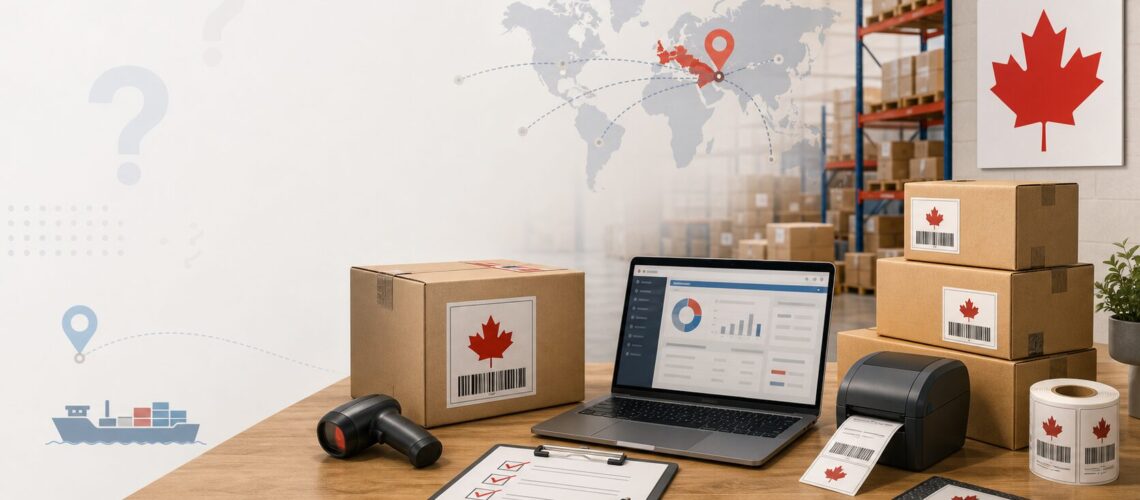
TL;DR: Use a Canadian prep center when you need to relabel, comply with 2026 FNSKU policy, route Amazon returns, or recover removal inventory. Amazon ended its in-FC labeling service on January 1, 2026, so sellers must now ship units pre-labeled. A prep partner lets overseas sellers comply, recover value, and save fees without a local address.
Welcome to the Amazon Prep FAQ Canada, a 2026 reference written for international and Chinese FBA sellers who ship into Amazon.ca and need a clear answer fast. Amazon prep — the umbrella term for FNSKU labeling, polybagging, bundling, returns routing, and removal recovery — is now the seller’s full responsibility after Amazon retired its FBA Label Service on January 1, 2026. This Amazon Prep FAQ Canada covers what a Canadian prep partner does, how to comply with the new 2026 FNSKU policy, how to relabel mixed inventory, how to route returns when you have no Canadian address, and how to recover value from removal orders. The goal is to help you decide when to prep, when to ship factory-direct, and how to save money across cross-border lanes. Twelve questions, twelve direct answers, with policy citations where it matters.
What is an Amazon prep center, and why do FBA sellers selling on Amazon Canada need one?
An Amazon prep center is a specialized facility that receives your inventory, inspects it, applies FNSKU labels, and forwards it to Amazon fulfillment centers in compliant cartons. Sellers shipping into Amazon Canada use one because Amazon enforces strict packaging, polybagging, and labeling rules, and rejected shipments lead to chargebacks or removal. Since Amazon ended its FBA Label Service on January 1, 2026, every unit must arrive at the FC already labeled. A Canadian Amazon prep center handles that step for you when your overseas factory cannot meet Amazon’s barcode and polybag specs.
Amazon ended its FBA Label Service on January 1, 2026, so every unit must arrive at the fulfillment center already FNSKU-labeled. International sellers on Amazon Canada use a Canadian prep center to inspect, label, and forward inventory in compliant cartons when an overseas factory cannot meet Amazon’s barcode and polybag specs.
Can I ship directly from China to Amazon Canada FBA without a prep center?
You can, but it rarely works cleanly at scale. Direct factory-to-FBA shipments fail most often on FNSKU placement, suffocation warnings, sets-and-bundle labeling, and case-pack count mismatches. Each rejection triggers an unplanned-service fee or a full removal. With Canada e-commerce projected at USD 45.66B in 2026 and growing at 9.27% CAGR (Mordor Intelligence, 2026), the cost of a single rejected shipment compounds quickly. A prep step lets you catch defects before Amazon does. For tested 2026 selection criteria, see this complete 2026 guide on choosing a prep center.
Is a US prep center good enough if I sell on Amazon.ca?
A US prep center is not optimal for Amazon.ca volume. Cross-border trucking from the US into Canadian Amazon FCs adds customs brokerage, duty, GST/HST handling, and 3 to 7 extra transit days per shipment. You also lose the ability to route Canadian customer returns back through a US address efficiently. A Canadian prep partner keeps your inbound lane domestic once goods clear customs, and gives you a local return endpoint. If you sell on both Amazon.ca and Amazon.com, splitting prep by destination marketplace usually nets lower total landed cost than a single US hub.
Who applies FNSKU labels now that Amazon ended its labeling service in 2026?
The seller is fully responsible for FNSKU labels as of January 1, 2026. Amazon retired its FBA Label Service and will no longer apply labels at the fulfillment center. Sellers now choose one of three paths: have the factory print FNSKUs at the source, use a Canadian or US prep center, or label in-house. For sellers using overseas factories — including manufacturers in China, Vietnam, India, or elsewhere — factory labeling often fails Amazon’s 1D barcode contrast and placement spec, so a dedicated FNSKU relabeling service at a Canadian prep partner is the safer route.
As of January 1, 2026, the seller is fully responsible for FNSKU labels because Amazon retired its FBA Label Service and no longer applies labels at the fulfillment center. Global sellers on Amazon Canada now choose one of three paths: factory labeling at source, a Canadian or US prep center, or in-house labeling.
When do I need FNSKU relabeling versus first-time FNSKU application?
You need first-time application when units arrive bare or with only a UPC. You need relabeling when units carry the wrong FNSKU, are commingled across SKUs, were transferred between Amazon accounts, or were originally labeled for the US (X00 codes) and must be reissued for the Canadian catalog. A second trigger arrives March 31, 2026, when Amazon ends FBA virtual tracking and commingling for new ASINs. Sellers with commingled stock will need to relabel every unit before resending it as standard FNSKU-tracked inventory.
How do overseas sellers route Amazon Canada returns without a local address?
You list a Canadian prep center as your default return address inside Seller Central. When buyers return units, Amazon ships them to the prep partner rather than back to your country. The prep team inspects each unit, photographs damage, grades it as resellable, repackable, or scrap, and either relabels it for re-shipment to FBA or holds it for liquidation. Without a Canadian return address, sellers either eat the unit cost or pay Amazon to dispose of it. Read the full workflow in our Amazon Canada returns guide for overseas sellers, or see the dedicated Amazon Canada returns processing page.
Overseas sellers on Amazon Canada route returns by listing a Canadian prep center as their default return address in Seller Central. Amazon then ships returned units to the prep partner, which inspects, photographs, and grades each unit as resellable, repackable, or scrap, then relabels it for re-shipment to FBA or holds it for liquidation.
Should I send Amazon Canada removal orders to a prep center or liquidate?
Send to a prep center when the inventory’s recoverable value exceeds the removal fee plus inspection cost. Amazon’s FBA removal fees in Canada start at CAD 0.30 per standard-size unit and rise with weight, so a CAD 25 retail unit is almost always worth recovering. Liquidate only when the per-unit recovery price after fees falls below the disposal fee. A Canadian removal order processing partner inspects, regrades, and reships viable units back to FBA, typically recovering 40-70% of stranded inventory value.
Send Amazon Canada removal orders to a prep center when recoverable value exceeds the removal fee plus inspection cost. Amazon’s FBA removal fees in Canada start at CAD 0.30 per standard-size unit, so a CAD 25 retail unit is almost always worth recovering. A prep partner reships viable units, typically recovering 40-70% of stranded value.
How much inventory value can I recover by routing returns through a prep center?
Industry-observed recovery ranges for inspected customer returns typically land around 55-75% resellable, 10-15% repairable seconds suitable for liquidation channels, and 10-30% true scrap, with exact splits varying by product category and inspection rigor. Soft goods and electronics accessories consistently outperform fragile and food-grade items in resellable share. Without a Canadian return endpoint, every one of those units becomes scrap by default because Amazon disposes of unreturnable inventory after a fixed holding window. For removal orders specifically, see Amazon FBA removal Canada filing, costs & recovery. Your recovery rate is mostly determined by how fast the inspection happens after return, not by the return itself.
What does a Canadian prep center actually do, step by step?
A Canadian prep center receives your inbound carton, scans it against your ASN, inspects each unit for damage, applies FNSKU labels, polybags items with suffocation warnings if required, bundles sets, applies expiration date stickers for consumables, builds an Amazon-compliant outbound carton, generates the FBA shipment in Seller Central, and books the carrier to the assigned FC. Optional steps include kitting, bubble-wrapping fragile units, and product photography. Each step is logged with timestamps so you can audit the chain of custody. This is distinct from a 3PL: a prep center exists to route inventory into FBA, not to fulfill direct-to-consumer orders.
How long does prep take, and what does it cost in Canada?
Turnaround at a competent Canadian prep partner runs 24 to 72 hours from receipt to outbound, depending on volume and prep complexity. Per-unit pricing typically ranges from CAD 0.45 to CAD 1.25 for standard FNSKU labeling, with bundling, polybagging, and inspection priced as add-ons. Pallet receiving usually costs CAD 5 to CAD 15. Compare quotes by total landed cost, not just per-unit rate, because storage fees and outbound-shipment line items vary widely. Amazon’s own FBA prep requirements drive most of the prep scope, so cheaper quotes often hide skipped steps.
What products can a Canadian prep center NOT handle?
Most Ontario-based prep centers will not handle hazmat without a TDG license, controlled goods, perishable food that requires refrigeration, alcohol, cannabis, firearms, prescription medication, or oversize units beyond their dock spec. Many also decline lithium-ion batteries above certain Wh thresholds. Always disclose product chemistry, weight, and Health Canada classification when requesting a quote, because misclassified hazmat can shut down a facility. If your SKU sits in a restricted category, ask the prep partner for written confirmation before booking your inbound freight. This is the most common gap left out of an Amazon Prep FAQ Canada conversation, and the one most likely to derail a launch.
How do I get started with a Canadian prep center as an international seller?
Start by sending the Canadian Amazon prep center your ASIN list, expected monthly volume, source country, and current pain points such as FNSKU rejections or unrouted returns. They will return a per-unit quote, an inbound address, and an SOP for your carton labeling and ASN format. Most onboarding takes 3 to 5 business days. Once your first inbound arrives, the prep team handles inspection, labeling, and FBA shipment creation inside your Seller Central account using a granted user permission. From that point you receive a per-shipment report with photos.
How to start working with a Canadian Amazon prep center
If this Amazon Prep FAQ Canada walkthrough has confirmed you need a local partner to handle FNSKU labels, returns routing, and removal recovery, the next step is a written quote. Submit your ASIN list and monthly volume through our Canadian Amazon prep center contact form and you will receive a per-unit price, an inbound address, and an onboarding SOP within two business days. International sellers without a Canadian return address can list us as your default return endpoint the day you onboard, so no returned units are stranded.
Sources
- Amazon Seller Central. “FBA Label Service ends January 1, 2026.” https://sellercentral.amazon.com/seller-forums/discussions/t/32e1d348-10b4-46ae-ae29-74a0cb3b182a
- Amazon Seller Central. “FBA commingling ends March 31, 2026 for new ASINs.” https://sellercentral.amazon.com/seller-forums/discussions/t/106d0747-e5c6-44d8-86f3-7669f11238fe
- Mordor Intelligence. “Canada E-commerce Market Size & Share Analysis, 2026.” https://www.mordorintelligence.com/industry-reports/canada-ecommerce-market
- Amazon Seller Central Canada. “FBA Removal Order Fees.” https://sellercentral.amazon.ca/gp/help/external/G200685050
- Amazon Seller Central Canada. “FBA Prep Requirements.” https://sellercentral.amazon.ca/gp/help/external/G201023020
Related FNSKU relabeling resources
If your prep issue is specifically label compliance, compare the Amazon FBA relabeling provider checklist for Canada and the FNSKU relabeling service page before sending inventory to Amazon.ca.
Related relabeling and recovery checklists
For vendor selection and recovery decisions, compare the Canada relabeling provider checklist and the liquidation vs return-to-prep recovery math guide.