
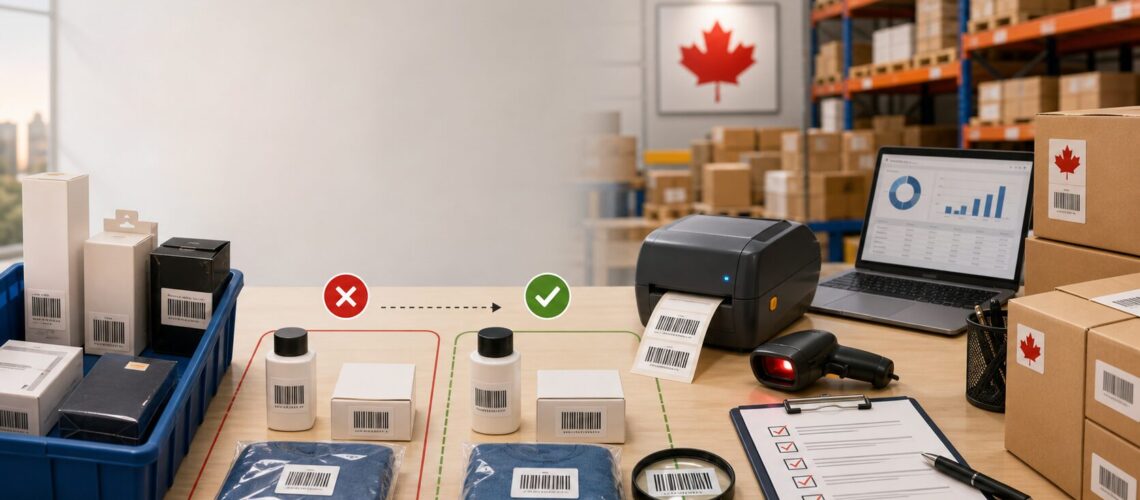
Checklist First: Use this page to vet a Canada-based relabeling vendor before you ship inventory. Compare providers on five decision filters: barcode compliance controls, 24-72h turnaround discipline, intake photo evidence, transparent per-unit pricing, and whether the operator can also receive Amazon Canada returns or removal orders.
Still deciding whether you need to relabel? See what an FNSKU is and how the barcode works.
This is not the main FNSKU relabeling service page. It is a buyer-side checklist for sellers who are shortlisting Canadian relabeling vendors and need to separate a real operating partner from a generic labeling offer. If your goal is to compare providers, pricing logic, intake controls, and risk points before handing off inventory, this page should do that work directly.
What should a Canada FBA relabeling vendor checklist include?
Amazon FBA relabeling services receive existing inventory, remove or cover incorrect FNSKU labels, apply the correct Amazon-compliant FNSKU barcode, and forward compliant cartons to an Amazon Canada fulfillment center. You need them when units arrived at FBA carrying the wrong FNSKU, when stock was originally labelled for a different marketplace (US X00 codes that have to be reissued for the Canadian catalog), when commingled inventory must be individually labeled before re-induction, or when factory-applied labels failed Amazon’s 1D barcode contrast and placement spec. The triggering event is almost always the same: a shipment was either rejected, partially removed, or flagged as a stranded SKU.
The single biggest 2026 trigger is the policy change Amazon announced last year. Amazon ended its FBA Label Service on January 1, 2026, which means the in-FC labeling option you may have relied on simply no longer exists. Every unit shipped to FBA now has to arrive already labelled — and that single change is why demand for Canada-based Amazon FBA relabeling service Canada providers spiked among overseas sellers.
When choosing a Canadian Amazon FBA relabeling provider, confirm it absorbed the January 1, 2026 end of Amazon’s in-FC FBA Label Service: every unit must now arrive pre-labelled to FNSKU spec. Pick a partner that receives inbound cartons, relabels each unit, and forwards compliant outbound shipments without a local seller address.
How to compare relabeling service providers on turnaround time
The most useful single metric when shortlisting an Amazon relabeling partner is receipt-to-outbound turnaround. A competent Canadian provider commits to 24–72 hours from receipt of your inbound carton to outbound to the assigned Amazon fulfillment center. Faster than 24 hours usually means corners are being cut on inspection. Slower than 72 hours becomes problematic during Q4, Prime Day, and Cyber 5 when every hour of storage delay compounds across your sell-through forecast. Ask for the partner’s average and 95th-percentile turnaround across the last 90 days, not just a marketing number.
A relabeling service in Canada that bundles labelling, polybag application, and inspection should also commit to a same-day photo report when goods arrive. If the partner cannot produce timestamped intake photos within four hours of dock acknowledgement, you have no chain of custody — which means any discrepancy later in the lane is your problem, not theirs.
Compare relabeling providers in Canada on receipt-to-outbound turnaround: a competent partner commits to 24–72 hours from inbound carton to Amazon fulfillment center. Ask for 90-day average and 95th-percentile figures, and require timestamped intake photos within four hours of dock acknowledgement to establish chain of custody.
FNSKU compliance: what a proper relabeling service catches
The point of paying for an external relabeling service rather than printing yourself is that the partner catches Amazon-side rejections before Amazon does. That means more than just slapping a sticker on a polybag. A compliant Canadian FNSKU relabeling service inspects each unit against Amazon’s 1D barcode contrast spec, validates the FNSKU is the correct code for the destination catalog (Canada uses different codes from amazon.com), checks placement (the label must not be on a seam, a curve, or cover the original UPC unless intentional), and confirms suffocation warning polybags are present on items that require them.
A second compliance layer matters for sellers carrying mixed inventory: as of March 31, 2026, Amazon ends FBA virtual tracking and commingling for new ASINs. Sellers whose stock was still commingled at that cutoff must now relabel every single unit before re-shipping it as standard FNSKU-tracked inventory. If your relabeling partner does not have a written intake procedure for commingled stock, you are paying retail prices for a service that will leave you with the same problem.
A relabeling provider worth choosing catches Amazon rejections before Amazon does: it inspects every unit against the 1D barcode contrast spec, validates the FNSKU matches the Canadian catalog (not amazon.com codes), checks label placement, and confirms suffocation-warning polybags. Demand a written intake SOP for commingled stock after the March 31, 2026 cutoff.
Cost benchmarks: what should a Canadian relabeling provider charge?
Per-unit Canadian relabeling pricing typically falls between CAD 0.45 and CAD 1.25 for standard FNSKU labeling on a flat or polybagged unit, with pallet receiving in the CAD 5 to CAD 15 range. Higher unit cost is normal for products that require bundling, sets-and-piece labeling, or expiration-date stickers for consumables. Compare quotes on total landed cost per shipment rather than per-unit rate alone. A provider quoting CAD 0.45 per unit but charging CAD 60 per outbound shipment and CAD 4 per pallet receipt can easily cost more than a competitor at CAD 0.85 per unit with no outbound surcharge.
The Amazon Seller Central reference for FBA prep, including labeling and packaging requirements, is the official FBA prep requirements page — use it to validate any quote against the actual Amazon spec rather than the provider’s marketing material. If a quote is materially cheaper than the CAD 0.45 floor, the provider is almost certainly skipping a step in the SOP.
Benchmark relabeling quotes in Canada against CAD 0.45–1.25 per unit for standard FNSKU labeling, plus CAD 5–15 pallet receiving. Compare providers on total landed cost per shipment, not per-unit rate alone: a CAD 0.45/unit quote with a CAD 60 outbound surcharge can cost more than CAD 0.85/unit with none.
When to use a Canadian relabeling service vs label in-house or at source
There are three legitimate places to apply FNSKU labels: at the factory before export, at a US prep center after import, or at a Canada-based relabeling service before FBA inbound. Each makes sense in a different scenario.
Factory labelling is cheapest when your supplier is technically capable and the FNSKU never changes — but most overseas factories struggle with the 1D barcode contrast spec, which is exactly why factory-labelled shipments get rejected at the FC. A US prep center works when most of your volume goes to amazon.com and only an occasional carton continues into Canada — but the cross-border truck adds GST/HST handling, customs brokerage, and 3 to 7 transit days that compound on every cycle. A Canadian Amazon FBA labelling service makes the most sense when you carry steady volume into Amazon.ca, because labels apply within the same border as the destination FC and customer returns flow back to the same address.
For a fuller comparison of when each path makes sense, the Amazon Prep FAQ Canada walks through twelve common cross-border decisions in plain language.
Choose a Canada-based relabeling provider over factory or US-prep labeling when you ship steady volume into Amazon.ca: labels apply inside the destination border and returns flow to the same address. A US prep center adds GST/HST handling, brokerage, and 3–7 cross-border transit days that compound every cycle.
Red flags when shortlisting a relabeling partner
A handful of warning signs separate a sustainable Canadian relabeling provider from a vendor that will quietly cost you more. Watch for: no published turnaround SLA, no documented intake SOP, no per-shipment photo reports, no transparent line-item pricing, and no written acceptance criteria for product categories they will not handle (hazmat, lithium-ion above certain Wh thresholds, controlled goods, alcohol). Watch also for vendors who describe themselves only as a “warehouse” rather than as an FBA prep or relabeling specialist — a generic 3PL is not the same operational discipline as a prep center, and the difference shows up the first time Amazon flags a shipment.
Equally important: confirm the provider can list itself as your default return endpoint inside Seller Central. Without that, returned units have nowhere to go, and the value recovery that an Amazon Canada returns guide describes never reaches your account.
How to onboard fast with a Canada-based relabeling provider
The fastest onboarding looks like this: send the provider a CSV of ASIN, expected monthly volume per SKU, source country, current pain points, and any product category notes (fragile, expiration-dated, hazmat). A working provider returns a written per-unit quote, an inbound carton address, an ASN format, and an SOP for outbound carton labeling within two business days. Onboarding closes when your first inbound carton arrives, the team scans it against the ASN, completes the FNSKU relabeling services workflow, and posts a photo intake report inside an hour.
From that point you receive a per-shipment summary with timestamps and unit counts. If the provider’s average time from dock to outbound stays inside the 24–72 hour window you agreed in week one, the relationship is working. If it slides past 72 hours twice in any thirty-day window without a written reason, raise it formally — drift in turnaround predicts drift in inspection quality.
Choosing the right Canadian relabeling partner
If you sell into Amazon.ca at any sustained volume and you do not have a Canadian local team, an Amazon relabeling and prep partner in Canada is one of the highest-leverage operational decisions you make in 2026. The FNSKU relabeling services decision is less about per-unit cost and more about whether the provider’s SOP, turnaround discipline, and inspection rigor protect you from the chargebacks, removals, and return write-offs that quietly erode cross-border margin. Use the five filters above to shortlist; insist on the photo intake report; and confirm in writing that the provider will list itself as your default Seller Central return endpoint.
Sources
- Amazon Seller Central. “FBA Label Service ends January 1, 2026.” https://sellercentral.amazon.com/seller-forums/discussions/t/32e1d348-10b4-46ae-ae29-74a0cb3b182a
- Amazon Seller Central. “FBA commingling ends March 31, 2026 for new ASINs.” https://sellercentral.amazon.com/seller-forums/discussions/t/106d0747-e5c6-44d8-86f3-7669f11238fe
- Amazon Seller Central Canada. “FBA Prep Requirements.” https://sellercentral.amazon.ca/gp/help/external/G201023020