
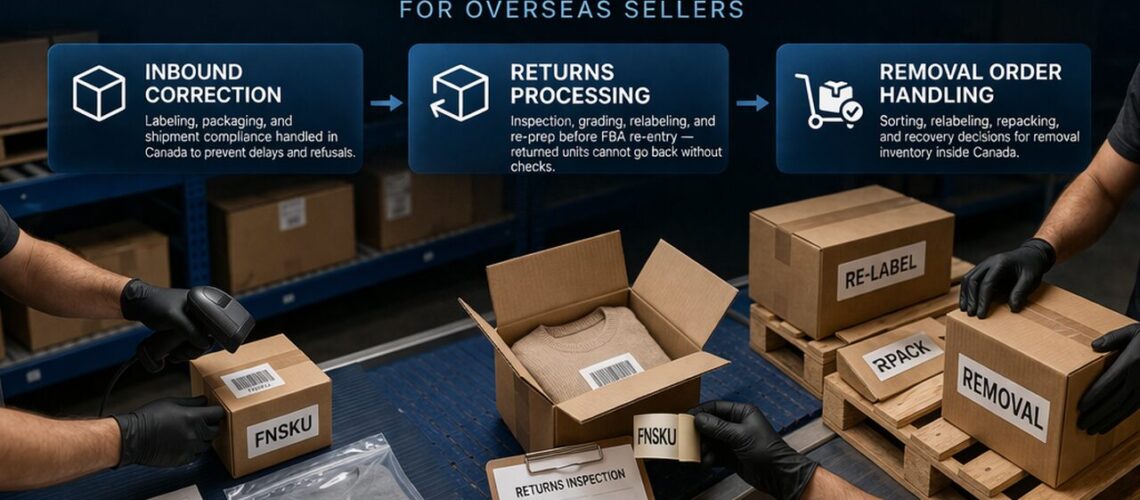
For many overseas sellers, “Amazon Canada inbound prep” sounds simple.
Apply the labels. Pack the cartons. Ship the inventory. Send it to FBA.
That is the common assumption.
But in real operations, Amazon Canada inbound prep is not just a packaging task. It is a Canada-side execution workflow.
The real risk begins when something does not go exactly as planned: labels are unreadable, cartons do not match, inventory is refused, returned units cannot go back into FBA directly, or removal stock has nowhere to be processed locally.
That is where many overseas sellers discover the same thing too late:
Amazon Canada inbound prep is not just about getting inventory ready. It is about having a local workflow in Canada when inventory needs intervention.
Why This Matters for Overseas Sellers
For sellers shipping from overseas into Amazon.ca, the biggest challenge is usually not creating the shipment.
The bigger challenge is what happens after the inventory reaches Canada.
If inbound inventory is delayed, refused, misrouted, or sent into a returns or removal workflow, the seller suddenly needs local execution support—not just instructions.
That is why this matters operationally:
- delayed inventory means missed selling time
- labeling mistakes can trigger rework and extra transport
- returned units cannot always be re-entered into FBA without inspection
- removal inventory often requires sorting, relabeling, repacking, or disposal decisions inside Canada
- without local support, small issues become expensive recovery problems
For overseas sellers, the issue is not only compliance. It is control.
Where Inbound Prep Actually Breaks Down
A lot of sellers still think inbound prep is complete once the shipment leaves origin.
In practice, that is only the first part.
The real execution problems usually appear at the Canada side.
1. Labeling Errors
Amazon’s requirements are strict, but the bigger issue is what happens when labels fail in real receiving workflows.
Typical problems include:
- missing FNSKU labels
- incorrect FNSKU labels
- unreadable or damaged labels
- labels placed incorrectly
- carton labels that do not match the shipment plan
These are not small details. They are common reasons inventory gets delayed, flagged, or rejected.
2. Delays, Misrouting, and FBA Rework
If carton information is wrong or shipment prep is inconsistent, inventory may not move cleanly through receiving.
That can lead to:
- receiving delays
- inventory rerouting
- extra handling
- rework before re-entry
- slower replenishment into FBA
For overseas sellers, those issues are harder to solve because the correction work must happen locally.
3. Returned Inventory Cannot Be Treated as Clean Stock
Returns are another area sellers often underestimate.
Returned units may be opened, incomplete, damaged, used, or mixed. Sending them back into FBA without inspection can create another cycle of customer complaints, refunds, and operational loss.
That is why returned inventory often needs:
- receiving
- inspection
- grading
- relabeling
- repacking
- re-entry decision-making
In other words, returns are not separate from prep. They are part of the broader Canada-side execution workflow.
4. Removal Inventory Needs a Recovery Path
When Amazon issues removal orders, the inventory still needs somewhere to go.
At that point, sellers need answers such as:
- can this inventory be recovered?
- does it need relabeling?
- does it need repacking?
- can it go back into FBA?
- should it be liquidated or disposed of?
Without a local execution path, removal inventory becomes a cost center instead of a recoverable asset.
What Amazon Canada Inbound Prep Actually Requires
In practical terms, Amazon Canada inbound prep requires more than labeling instructions.
It requires a Canada-based workflow that can handle both initial prep and post-arrival intervention.
That typically includes:
- local receiving
- quantity and packaging checks
- FNSKU relabeling
- polybagging or compliant prep correction
- carton relabeling
- shipment correction before FBA delivery
- inspection of returned inventory
- staging and recovery handling for removal stock
- re-prep for FBA re-entry when applicable
This is why a true Amazon Prep Center Canada function matters.
It is not just about preparing inventory once. It is about maintaining inventory movement when reality creates exceptions.
Why Local Execution Changes the Outcome
For overseas sellers, the difference is simple:
Without local execution, every Canada-side problem becomes slower, more expensive, and harder to control.
With local execution, sellers gain a working path for:
- inbound correction
- labeling fixes
- rework before FBA re-entry
- returns inspection
- removal order handling
- inventory recovery decisions
This is the key correction many sellers need to understand:
Amazon Canada inbound prep is not a one-step shipping task. It is part of a local operating system.
Related Seller Services
If your inventory needs Canada-side intervention, these workflows usually connect together rather than exist separately.
Related seller services include:
- Amazon Prep Center Canada
- Amazon Returns Processing Canada
- Amazon Removal Order Processing Canada
Learn more about our Amazon Prep Center Canada service.
See how returned inventory can be handled in Canada before FBA re-entry.
See how removal inventory can be processed for recovery in Canada: