
For sellers shipping inventory into Amazon Canada, regional allocation is only part of the execution picture. If your inventory needs FNSKU relabeling, returns handling, or removal order processing inside Canada, see our Amazon Prep Center Canada service.
Definition Summary
Amazon regional allocation in Canada is the automated process of distributing inventory across fulfillment centers based on geographic demand, capacity optimization, and logistics efficiency.
It determines where your inventory is stored — and often explains why sellers are routed to facilities such as YXU1 in St. Thomas, Ontario.
What Is Amazon Regional Allocation?
Amazon Regional Allocation is part of Amazon Canada’s regionalized fulfillment network.
Instead of assigning inventory to a single centralized warehouse, Amazon distributes stock across multiple regional execution nodes based on:
- Customer demand patterns
- Transportation efficiency
- Fulfillment center capacity
- Cross-border flow optimization
In practical terms, this means:
Your inventory may not go where you expect — but where the algorithm decides it should.
This shift has become more visible under Amazon’s 2026 regionalization strategy, where logistics efficiency often outweighs seller preference.
Why Amazon Uses Regional Allocation in Canada
Amazon’s Canadian fulfillment system is no longer purely GTA-centric.
Regional allocation allows Amazon to:
1️⃣ Balance Capacity
Greater Toronto Area (GTA) fulfillment centers have historically handled a high volume of inbound inventory.
Regional nodes such as YXU1 help reduce congestion and prevent bottlenecks.
2️⃣ Improve Delivery Speed
By positioning inventory closer to Southwest Ontario demand clusters, Amazon shortens last-mile delivery time.
Regional placement supports:
- Faster Prime delivery
- Reduced dock-to-stock time
- Lower internal transfer load
3️⃣ Optimize Cross-Border Corridors
Canada’s logistics network interacts with U.S. corridors through Michigan and Buffalo routes.
Regional allocation supports smoother inbound routing and more efficient domestic distribution.
How Regional Allocation Affects Sellers
For sellers, regional allocation can feel unpredictable.
You may notice:
- Inventory assigned to an unexpected fulfillment center
- Routing to facilities such as YXU1
- Redistribution across multiple FCs
This is not random.
It is algorithm-driven execution balancing.
Facilities like YXU1 in St. Thomas function as regional execution nodes within this system.
If you want a deeper breakdown of that facility specifically, see our analysis of YXU1 here:
Understanding YXU1: A Regional Fulfillment Node Reshaping Amazon Canada’s Logistics Network
Does Regional Allocation Change Seller Strategy?
Not always — but sometimes.
Sellers should monitor allocation patterns when:
- Restock speed becomes critical
- Removal or redeployment is required
- Inventory velocity drops unexpectedly
- Regional stockouts occur
In most cases, intervention is unnecessary.
But understanding the allocation logic helps you distinguish between:
Operational fluctuation
and
Strategic execution shift.
Regional Allocation and YXU1
Under Amazon’s 2026 logistics optimization, YXU1 represents a regional execution model.
It is not simply “another warehouse.”
It supports:
- Southwest Ontario demand balancing
- High-velocity inventory handling
- Reduced GTA congestion
If your inventory is routed to YXU1, it is typically part of regional distribution strategy — not an error.
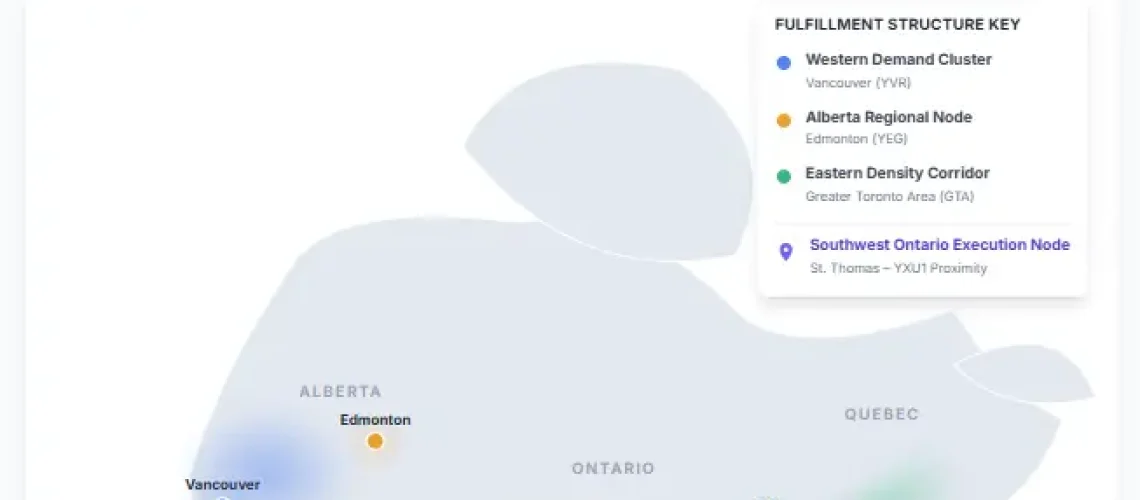
Canada Fulfillment Allocation Structure (2026)
Understanding how inventory flows between Western and Eastern execution corridors.
Canada Fulfillment Allocation Structure (2026)
Regional Demand Corridors & Execution Nodes
Title
TypeDescription goes here.
Fulfillment Structure Key
Western Demand Cluster
Vancouver (YVR)
Alberta Regional Node
Edmonton (YEG)
Eastern Density Corridor
Greater Toronto Area (GTA)
Southwest Ontario Execution Node
St. Thomas – YXU1 Proximity
Why Location Matters in FBA Recovery
Amazon Canada operates primarily along two major axes: The Western Demand Cluster and the Eastern Fulfillment Density Corridor. Understanding this geographic split is critical for inventory placement and cost mitigation.
When inventory is routed within the Eastern corridor, removal orders and returns are typically processed inside this execution band. Proximity to the GTA and YXU1 significantly reduces cross-region transfer delays.
If your inventory is routed to YYZ or YXU1, your recovery speed depends on geography.
See How FBA Removal Orders Are Recovered Inside the Eastern CorridorFAQ – Direct Answers
Amazon regional allocation in Canada is Amazon’s automated system for distributing inventory across fulfillment centers based on geographic demand, capacity optimization, and logistics efficiency.
Inventory may be routed to a different fulfillment center when Amazon’s system determines that regional placement improves delivery speed or balances capacity within the fulfillment network.
Regional allocation does not directly change your standard FBA fulfillment (pick-and-pack) fees. However, during shipment creation, choosing a single receiving center versus splitting shipments across multiple regional centers may affect whether you incur an Inbound Placement Service Fee.
No. Sellers cannot manually select a specific fulfillment center by name or location. While you may choose your inbound configuration (e.g., single shipment or multiple split shipments), the final destination warehouses are determined by Amazon’s regional allocation algorithm.
YXU1 operates as a regional execution node within Amazon Canada’s allocation strategy, supporting Southwest Ontario demand and reducing congestion in GTA-based facilities.
Related Seller Services in Canada
Amazon Prep Center Canada — Full-service prep support for overseas sellers shipping inventory into Canada.
Amazon Returns Processing Canada — Inspect, relabel, and recover returned inventory for resale or FBA re-entry.
Amazon Removal Order Processing Canada — Receive and process Amazon removal inventory for recovery and re-entry.
Understanding Amazon’s regional allocation model helps sellers interpret where inventory moves, but execution inside Canada matters more. When inventory requires relabeling, return handling, or removal order recovery, a local prep workflow is what determines speed and recovery value.
Learn more about our Amazon Prep Center Canada service.