
Decision Math: Use this page when you need to choose between liquidation and return-to-prep on actual recovery economics. The core question is not whether liquidation is fast. It is whether the cash recovered after removal fees, payout delay, and resale probability beats the recoverable margin from inspection, relabeling, and relisting.
This page is not the general returns-processing service explainer. It is a recovery-math comparison page for sellers who need to decide what to liquidate and what to route back through prep. If you are comparing payout percentage, delay, removal fees, and recoverable margin by SKU, this page should answer that directly.
For per-SKU logic on whether to hold, remove, liquidate, or dispose, see our inventory decision framework.
What does Amazon liquidation actually recover after fees and delay?
Amazon FBA Liquidations recovers a recovery value typically cited at 5-10% of an item’s average selling price (ASP) (Amazon Seller Central, 2026; corroborated by ecomEngine, 2025). Amazon routes your units to B-Stock wholesale buyers or third-party liquidators. You get speed and zero handling. You also surrender most of the value.
Think about what that means on a $40 product. A 5-10% recovery returns roughly $2 to $4 per unit before fees. For thin-margin sellers, that barely covers the cost of goods, let alone freight into Canada. Liquidation isn’t free money. It’s salvage.
Amazon FBA Liquidations recovers a value typically cited at 5-10% of an item’s average selling price, with units sold to B-Stock wholesale buyers or third-party liquidators (Amazon Seller Central, 2026). On a $40 product, that returns roughly $2 to $4 per unit before fees.
Here’s the part sellers miss. Liquidation recovery is a percentage of ASP, not of your cost. So the items most likely to “make sense” to liquidate, low-cost commodity stock, are also the ones where 5-10% recovers almost nothing. The economics quietly punish the inventory you care least about.
For the broader hold-or-dispose decision, lean on the removal, liquidation, or hold framework.
Is it better to liquidate or return-to-prep FBA inventory in Canada?
For most customer-returned and aged stock, return-to-prep recovers far more than liquidation, often the difference between salvage and resale. Liquidation recovers ~5-10% of ASP (ecomEngine, 2025). In MoRo Prep’s experience, sellers who route stock to a prep center for inspection and FNSKU relabeling typically recover 60-80% of value instead. That gap is the whole decision.
The trade-off is real. Liquidation is fast and hands-off. Return-to-prep takes time, requires a Canadian receiving address, and only pays off when units are genuinely resellable. So which inventory deserves the effort? Anything with healthy margin, brand value, or units that are returned but undamaged.
Below is the side-by-side recovery economics we use with sellers when triaging a removal order.
| Value-recovery path | Typical recovery (% of value) | Speed | Best for |
|---|---|---|---|
| Disposal | 0% | Immediate | Damaged, expired, recalled, or banned units |
| Liquidation (Amazon / B-Stock) | ~5-10% | Fast (60-90 day payout) | Low-value, bulky, or unrecoverable stock |
| Return-to-prep (inspect, relabel, re-list) | ~60-80%* | Slower (handling + relisting) | Margin-rich, resellable, lightly returned units |
*Return-to-prep figure reflects MoRo Prep operational experience and is illustrative, not published third-party research. Liquidation and disposal figures per Amazon Seller Central and ecomEngine.
For most resellable FBA stock, return-to-prep recovers far more than liquidation. Liquidation pays ~5-10% of ASP (ecomEngine, 2025), while inspect-relabel-resell can recover 60-80% in MoRo Prep’s operational experience. The gap is the difference between salvaging stock and reselling it.
Want the full returns playbook for overseas sellers? See our Amazon Canada returns guide.
How much does it cost to remove inventory from Amazon Canada?
Amazon Canada FBA removal fees range from CAD $0.36 per unit for standard small items up to CAD $5.70 per unit for oversize units needing special handling (Amazon Seller Central CA, 2026). Removal sends units to an address you choose. That’s the on-ramp to return-to-prep, because units must leave Amazon before any prep center can touch them.
Fees scale with size and weight, so do the math per SKU before pulling stock. Always verify current tiers in Seller Central, since Amazon adjusts fees regularly.
| Unit type (Amazon Canada) | Removal fee (CAD / unit) |
|---|---|
| Standard small | $0.36 (lowest tier) |
| Standard / mid-size | Mid-range, scales with weight |
| Oversize, special handling | $5.70 (highest tier) |
Amazon Canada FBA removal fees run from CAD $0.36 per unit (standard small) to CAD $5.70 per unit (oversize special handling), charged per unit and scaling with size and weight (Amazon Seller Central CA, 2026). Verify current tiers in Seller Central, as Amazon updates fees regularly.
For the step-by-step filing process and recovery math, read our Amazon FBA removal Canada guide.
Can removed Amazon inventory be inspected, relabeled (FNSKU), and resold instead of liquidated?
Yes. Once units are removed to a Canada-based prep center, they can be inspected, repackaged, FNSKU-relabeled, and sent back into FBA as fresh sellable stock. In MoRo Prep’s experience, this recovers roughly 60-80% of value versus the ~5-10% liquidation pays (ecomEngine, 2025). Customer returns are often undamaged, just opened, mislabeled, or in scuffed packaging.
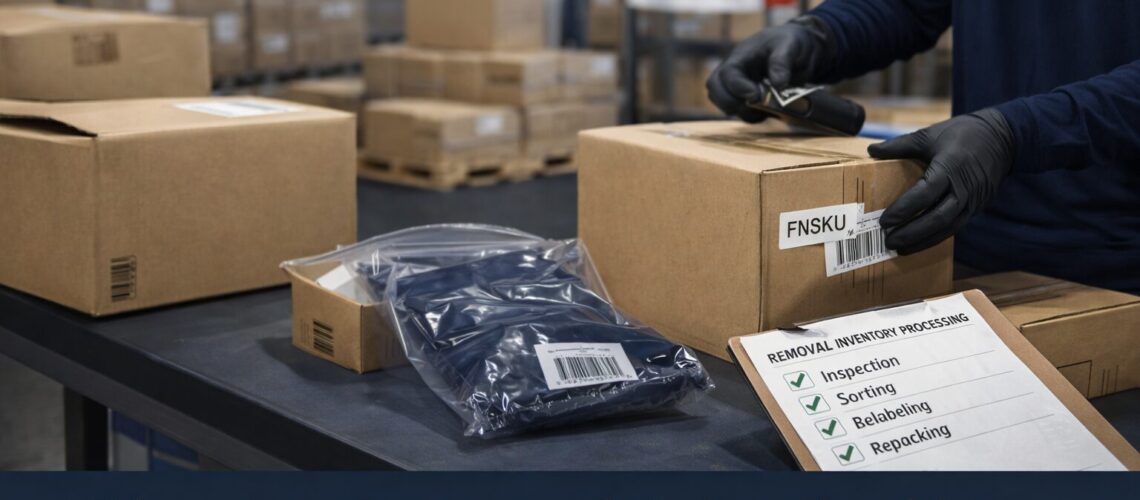
The workflow is simple in shape. Receive the removal order, inspect each unit, separate resellable from scrap, repackage, apply a new FNSKU, then reship into Amazon Canada. Damaged units get disposed; everything else earns its second life.
When we process customer-return removal orders, a large share of units arrive resellable after nothing more than a fresh poly bag and a new FNSKU label. Those are the units liquidation would have sold for pennies. The inspection step is where the value actually lives.
Removed Amazon units can be inspected, repackaged, and FNSKU-relabeled at a Canada-based prep center, then reshipped into FBA as sellable stock, recovering an estimated 60-80% of value versus ~5-10% via liquidation (ecomEngine, 2025). Most customer returns need only repackaging and a new label.
What happens to unsold FBA inventory after September 30, 2025 if I do nothing?
If you take no action, Amazon now makes liquidation or donation the default path for aged inventory, a policy that took effect September 30, 2025. Doing nothing means accepting the ~5-10% recovery liquidation pays (Amazon Seller Central, 2026). The decision is no longer optional. Inaction is itself a choice, and an expensive one.
This raises the urgency for cross-border sellers. Aged stock crosses long-term storage thresholds, then auto-liquidates while you’re not watching. Set removal triggers before that happens.
As of September 30, 2025, Amazon makes liquidation or donation the default path for aged FBA inventory when a seller takes no action, locking in the ~5-10% liquidation recovery rate (Amazon Seller Central, 2026). Sellers must set proactive removal triggers to preserve recoverable value.
Decide your per-SKU defaults using the inventory decision framework.
As an overseas seller with no Canadian address, how do I receive a Canada removal order?
You can’t, directly, and that’s the structural problem. Amazon Canada removal orders ship to a Canadian address only, with fees from CAD $0.36 to $5.70 per unit (Amazon Seller Central CA, 2026). Sellers shipping into Amazon Canada from China, the US, the EU, or the UK rarely hold a local receiving address. So a Canada-based prep center becomes the destination.
This is the quiet reason overseas sellers default to liquidation: not because the economics favor it, but because they have nowhere in Canada to send a removal order. The missing local address, not the math, pushes them into the worst-paying option. A prep center removes that constraint and unlocks the 60-80% path.
You list the prep center as the ship-to on the removal order. Units arrive, get triaged, and either return to FBA or get responsibly disposed. No Canadian entity required on your side.
Amazon Canada removal orders ship only to a Canadian address, so overseas sellers without a local presence often default to liquidation by necessity, not economics (Amazon Seller Central CA, 2026). Listing a Canada-based prep center as the removal ship-to address unlocks inspect-and-resell value recovery.
How long does a liquidation payout take?
Amazon FBA Liquidations payouts typically take 60-90 days after the liquidation settles, on top of a fee structure of a 15% referral fee plus a per-unit processing fee around $0.25-$0.40 (ecomEngine, 2025). So liquidation isn’t just lossy on value. It’s slow on cash. You wait two to three months for a few cents on the dollar.
Return-to-prep also takes time, but the payoff is resellable inventory that earns full margin once relisted. Compare the wait against the recovery, not in isolation.
Amazon FBA Liquidations charges a 15% referral fee plus a per-unit processing fee of roughly $0.25-$0.40, with payouts arriving in 60-90 days (ecomEngine, 2025). Sellers wait two to three months to recover only 5-10% of ASP, making liquidation slow on both value and cash flow.
Ready to recover more than salvage value?
Liquidation has its place, for damaged, bulky, or genuinely unrecoverable stock. But for resellable returns and margin-rich SKUs, routing units to a Canada-based prep center to inspect, relabel, and re-list recovers far more. If you sell on Amazon Canada from overseas, MoRo Prep is your Canadian removal-order destination.
Start with our returns processing service for Amazon Canada to turn removal orders into resellable inventory. Need just the labeling step? See FNSKU relabeling in Canada.
Frequently Asked Questions
Does Amazon Canada liquidation pay the same as the US program?
Amazon FBA Liquidations recovers a similar value range, typically cited at 5-10% of ASP, across marketplaces (Amazon Seller Central, 2026). The recovery percentage is the constraint, not the currency. The same salvage economics apply whether you liquidate on Amazon Canada or Amazon US.
Is return-to-prep worth it for low-cost items?
Often not. When liquidation pays 5-10% of ASP (ecomEngine, 2025) and removal costs CAD $0.36-$5.70 per unit, cheap commodity stock rarely clears the math. Return-to-prep shines on margin-rich, resellable units, not on disposable low-value inventory better suited to liquidation or disposal.
Can I split a removal order between resale and disposal?
Yes. A Canada-based prep center inspects each unit and separates resellable stock from scrap. In MoRo Prep’s experience, recoverable units reach 60-80% of value while damaged units get responsibly disposed. For per-SKU triage logic, see our decision framework.
How fast do I need to act on aged inventory?
Quickly. Since September 30, 2025, Amazon liquidates or donates aged stock by default if you do nothing, locking in the ~5-10% recovery rate (Amazon Seller Central, 2026). Set removal triggers before units cross long-term storage thresholds and auto-liquidate.
What’s the biggest mistake overseas sellers make with returns?
Defaulting to liquidation because they lack a Canadian address. North American consumers return nearly $849.9 billion in goods yearly (NRF, 2025). Much of that is resellable. A Canada-based prep center as your removal ship-to address recovers the value most sellers throw away.
The bottom line
The choice between liquidation and return-to-prep is really a choice about how much value you’re willing to forfeit. Liquidation pays 5-10% of ASP, takes 60-90 days, and locks in a loss. Return-to-prep can recover 60-80% in MoRo Prep’s experience, turning customer returns back into sellable inventory. For overseas sellers, the real barrier was never the math. It was the missing Canadian address. Solve that, and your worst-paying default disappears.
Decide what to liquidate, recover, hold, or dispose using the inventory decision framework, then route resellable stock through a Canada-based prep center.
