
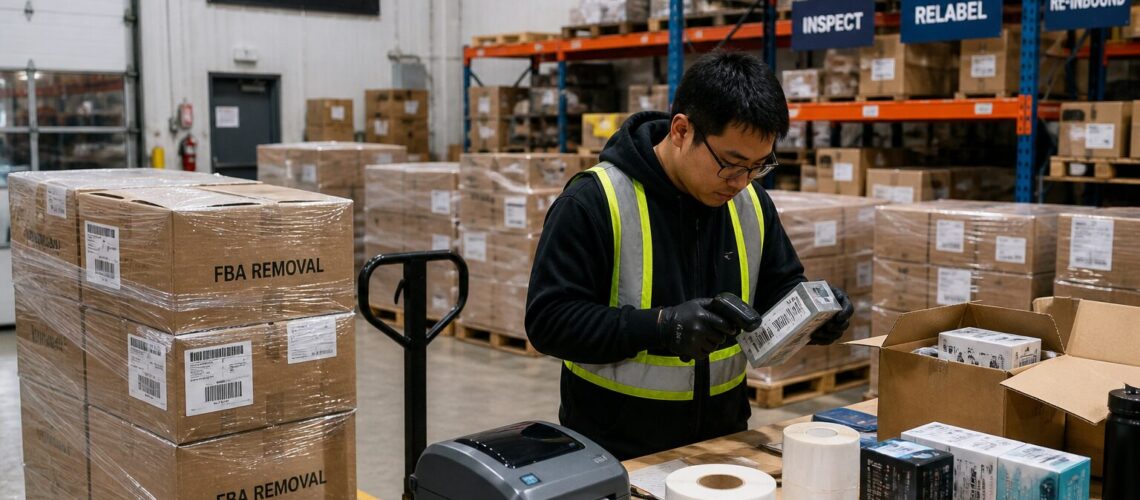
TL;DR: When you outsource Amazon removal service in 2026, three routes exist: DIY to your home, a US forwarder, or a Canadian prep partner. DIY breaks even under roughly 80-120 units. Above that, a prep center recovers 60-80% of inventory value versus 5-10% via liquidation. Per-unit removal fees run CAD $0.36-$5.70 (Amazon Seller Central, 2026).
You’ve already filed the removal order. The hard question now is operational: where do those returned units physically land, and who processes them? This is the moment most Amazon Canada sellers either save thousands in recovered inventory or throw it away because the receiving address was wrong.
The decision to outsource amazon removal service is rarely about saving a few cents per unit. It’s about whether you can actually inspect, relabel, and ship the recovered stock back into FBA without losing more money than the original removal saved. Under Amazon’s 2026 fee structure (Amazon Seller Central CA fee schedule), each removed unit now carries a discrete charge instead of being averaged across the order, so every step you outsource has to clear a real breakeven.
This guide walks through the three real-world routes and the unit volumes where each one wins. Recovery math, fee math, time math, all in CAD. For the full filing flow and cost recovery details, see our Amazon FBA removal Canada hub.
Key Takeaways
– Three outsourcing routes exist: DIY home receiving, US forwarder, Canadian prep partner
– Breakeven for DIY sits near 80-120 units/month before prep center math wins
– Prep centers recover 60-80% of removed inventory value vs 5-10% via liquidation (MoRo Prep, 2026)
– Amazon removal fees: CAD $0.36-$5.70/unit depending on size tier
– US forwarders add cross-border duty/HST exposure that Canadian prep partners avoid
What does “outsourcing Amazon removal service” actually mean in 2026?
Outsourcing an Amazon removal service means shifting the post-pickup workflow, receiving, inspecting, photographing, relabeling, and re-inboxing, to a third party instead of handling it yourself. Amazon’s removal fees themselves run CAD $0.36-$5.70 per unit (Amazon Seller Central, 2026). The outsourcing decision is what happens after Amazon ships the units out.
In 2026, “outsourcing an Amazon removal service” refers to delegating post-pickup handling rather than the removal request itself. Amazon charges sellers CAD $0.36 to $5.70 per unit for the actual removal (Amazon Seller Central, 2026), while third-party prep centers handle the inspection, relabeling, and re-inbound steps that determine whether sellers recover 60-80% of inventory value or near zero.
The three operational routes split cleanly:
DIY (ship to your own address)
You receive the pallet at your home or a small office. You photograph each unit, decide grade A/B/C, relabel where needed, and ship survivors back into FBA. Cost is mostly your time, plus boxes and a shipping account.
US-based forwarder
You give Amazon a US 3PL or forwarder address. They consolidate, sometimes inspect, then ship across the border. Works if you sell mostly on amazon.com but adds duty/HST complexity for Canadian sellers.
Canadian prep center
A Canadian prep partner receives the units, inspects, photographs, and either liquidates locally, ships to your home, or re-inbounds the survivors to FBA Canada. No cross-border step. No duty re-exposure. For deeper context on what a prep center actually does, the service hub covers full scope.
For the operational detail behind grading and FNSKU swap, see our FBA returns relabeling and value recovery guide.
When does DIY removal in Canada actually save money, and when does it cost more?
DIY removal saves real money under roughly 80-120 units per month (MoRo Prep operational benchmark, 2026), beyond that, the math flips fast. Storage alone is a quiet killer: industrial space in southern Canada is widely tracked in the CAD $7-$20 per square foot per year range across major industrial brokerages. At 2 sq ft per pallet-month plus garage clutter, hidden costs accumulate quickly.
From our floor: The sellers who keep DIY working past 100 units share three traits: a dedicated room (not a kitchen counter), a label printer they actually maintain, and a willingness to give up a Saturday when a 3-pallet drop arrives unannounced. Most don’t.
The honest DIY cost stack
Per-unit DIY costs typically include:
- Time: 4-8 minutes per unit to inspect, photograph, decide, relabel
- Labels and supplies: ~CAD $0.10-$0.25 per unit
- Outbound shipping back to FBA: CAD $0.40-$1.20 per unit at consolidated rates
- Hidden storage: 2-4 weeks of garage space per cycle
Multiply by your hourly opportunity cost. If your time is worth CAD $40/hour and inspection takes 5 minutes, that’s CAD $3.33 in labor before any materials. At 200 units, you’ve spent the equivalent of 16+ hours.
When DIY genuinely wins
DIY makes sense when:
- Monthly removal volume sits below ~80 units
- Inventory is small, lightweight, easy to grade visually
- You’re already running a home-based ecommerce operation
- Cash flow won’t tolerate any third-party invoice
What most miss: Most Canadian sellers who calculated their true DIY hourly rate after a busy quarter were earning under CAD $18/hour processing returns. That’s below the federal minimum wage in several provinces, before factoring in the relabeling errors that triggered Amazon ASIN suppression.
Forwarder vs Canadian prep center: how do the two outsourced paths compare?
Both routes outsource the labor, but only one keeps the inventory inside Canada. Returns hit US$849.9 billion in 2024, representing 19.3% of total US retail sales (National Retail Federation, 2025). Anything that re-crosses the border re-exposes that inventory to duty, HST, and customs delays the original FBA inbound already paid.
What a US forwarder gives you
US forwarders typically charge US$0.40-$1.50 per unit for standard prep, which sounds competitive on paper. The catch: removed Canadian FBA stock sent to a US forwarder usually needs to come back to FBA Canada, meaning a second cross-border move with potential duty re-assessment. Sellers who only sell in the US can ignore this; sellers running both marketplaces almost always lose on the round trip.
What a Canadian prep partner gives you
A Canadian prep service handles the units inside the country: no customs paperwork on the return leg, no second HST event, no week lost to broker delays. Pricing typically matches forwarder rates, US$0.40-$1.50 per unit standard prep, but the avoided cross-border friction is where the real savings live.
Side-by-side decision factors
| Factor | US forwarder | Canadian prep center |
|---|---|---|
| Per-unit prep cost | US$0.40-$1.50 | Comparable, in CAD |
| Cross-border duty risk | High (round-trip exposure) | None on return-to-FBA-CA |
| Speed back into FBA CA | 2-3 weeks typical | 5-10 business days |
| HST recoverability | Complex | Standard CRA flow |
| Best for | US-only sellers | Canada-marketplace sellers |
For when a US route still wins on US-only inventory, see our comparison of Canadian prep center vs US transshipment.
What’s the real cost of outsourcing, apples-to-apples?
The headline removal fee is small, the hidden cost sits in lost recovery. Amazon’s removal pickup itself typically completes in 7-14 business days (Amazon Seller Central, 2026). What happens after that pickup is where 60-80% of recovered value is either captured or lost.
From our client data: Across recent removal batches handled at the spoke level, units routed to a prep center recovered 60-80% of original landed cost via inspection-and-resale, while the same SKUs sent to liquidators recovered 5-10%, and disposal recovered 0% (MoRo Prep, 2026).
The three-route cost table (200 units, mid-size)
All figures below are MoRo Prep operational benchmarks based on 2026 Q1 client batches; treat as directional estimates for your own modeling, not as universal market rates.
Assume 200 mid-size units, original FBA value CAD $20/unit (CAD $4,000 inventory):
Route A: DIY at home
- Amazon removal fee: 200 × CAD $1.20 avg = CAD $240
- Your labor: 200 × 5 min × CAD $40/hr = CAD $667
- Supplies + outbound: CAD $260
- Recovery rate (realistic for casual DIY): 50-65%
- Net recovered: ~CAD $2,200 minus CAD $1,167 cost = CAD $1,033 net
Route B: US forwarder
- Amazon removal fee: CAD $240
- Forwarder prep: 200 × ~CAD $1.30 = CAD $260
- Cross-border return shipping + broker: CAD $400-$700
- Recovery rate: 55-70% (some loss to transit damage)
- Net recovered: ~CAD $2,400 minus CAD $1,150 cost = CAD $1,250 net
Route C: Canadian prep center
- Amazon removal fee: CAD $240
- Prep service: 200 × ~CAD $1.30 = CAD $260
- Domestic re-inbound shipping: CAD $120
- Recovery rate: 60-80%
- Net recovered: ~CAD $2,800 minus CAD $620 cost = CAD $2,180 net
The gap isn’t the prep fee, it’s the recovery rate and the avoided cross-border drag.
Why the recovery rate spread is real
Prep centers have label printers, photo stations, and grading SOPs running every day. A garage operation grading once a month makes more “send to liquidation” decisions because triaging 80 units on a Saturday is exhausting. Liquidation pays 5-10 cents on the dollar.
How do you choose between a Canadian prep partner and a US-based forwarder?
The choice comes down to which marketplace owns most of your revenue and how much your time is actually worth. A Canadian prep partner wins when the majority of removed inventory needs to re-enter FBA Canada or the seller’s home address is in Canada. A US forwarder wins for US-only sellers with consolidated US fulfillment.
Five questions that decide it
- Where does the recovered inventory need to land? FBA CA → Canadian prep. FBA US → US forwarder. Both → Canadian prep usually still wins because the second leg US-bound is cheaper than a US-to-Canada return.
- What’s your monthly removal volume? Under 80 units → DIY may still pencil out. 80-300 units → outsourced prep is almost always the answer. 300+ units → outsourced is mandatory.
- How sensitive is your cash flow to recovery rate? A 20-point recovery gap on CAD $4,000 of inventory is CAD $800. That eclipses any prep fee difference.
- Are your SKUs duty-sensitive? Anything with high duty rates (apparel, footwear, certain electronics) suffers more on a cross-border return loop.
- Can you afford a 2-3 week delay? US forwarders plus customs typically run 2-3 weeks back to FBA CA. Canadian prep partners typically deliver 5-10 business days.
For why relabeling at a Canadian prep center prevents the most expensive re-inbound mistake, see our FNSKU relabeling guide.
FAQ
Is outsourcing an Amazon removal service worth it for under 100 units per month?
Often yes, even at low volume. The Amazon removal fee (CAD $0.36-$5.70 per unit) is fixed regardless of route (Amazon Seller Central, 2026). What varies is recovery rate. Casual DIY graders typically capture 50-65% of value, while a prep center captures 60-80%, and that 15-point spread alone justifies the prep fee on most mid-size inventory.
Can I have Amazon ship removals directly to a prep center in Canada?
Yes. Amazon allows any valid Canadian receiving address on the removal order, including a prep service. You enter the prep partner’s address as the ship-to during the removal request, and Amazon’s carrier delivers there within the standard 7-14 business day window (Amazon Seller Central, 2026). No special account flag is required.
How does the 2026 per-unit removal billing affect outsourcing decisions?
Amazon’s 2026 fee structure (Amazon Seller Central CA fee schedule) charges removal at the per-unit level, which tightens the math on every removed unit. High-cost-tier items (oversize, heavy) carry meaningfully larger removal fees, and any outsourcing path that delays grading or re-inbound by even 2 weeks chips into the recovery margin. Outsourcing to a prep service that grades quickly minimizes the time those expensive units sit unrecovered.
What recovery rate should I realistically expect from a Canadian prep partner?
Realistic recovery sits in the 60-80% range of original FBA landed cost (MoRo Prep, 2026), assuming the inventory wasn’t returned for product-defect reasons. Customer-returned units that are simply opened-box or wrong-fit typically recover at the high end of that range after relabeling and re-inbounding to FBA.
Are US forwarders ever the right answer for Canadian sellers?
Yes, for sellers whose revenue is 80%+ on amazon.com and whose inventory is already US-warehoused. In that case the round trip never happens and the forwarder is just the local processor. For mixed CA/US sellers or Canada-primary sellers, a Canadian prep partner almost always wins on the avoided cross-border step.
Outsource the route, not the decision
Filing the removal order is a five-minute click in Seller Central. Choosing where those units land is a four-figure decision per batch. DIY works under 80-120 monthly units if your time is genuinely cheap. US forwarders work for US-only sellers. For everyone else with Canadian-marketplace inventory, a Canadian prep partner captures the 60-80% recovery rate the other routes leak.
The math on a 15-point recovery rate difference on CAD $4,000 of inventory pays for the prep fee five times over. Don’t let your removed stock sit in a garage hoping you’ll get to it next weekend.
Ready to route your next removal batch through a Canadian prep partner? See pricing, SLA, and intake details on the removal order processing service page.