
If you sell on Amazon.ca from outside Canada, the fulfillment centre your inventory lands in affects more than receiving speed. It changes how quickly units go live, how returned inventory gets recovered, and whether a removal order is even worth placing.
If your inventory needs local FNSKU relabeling, returns handling, or removal order processing in Canada, see our Amazon Prep Center Canada service.
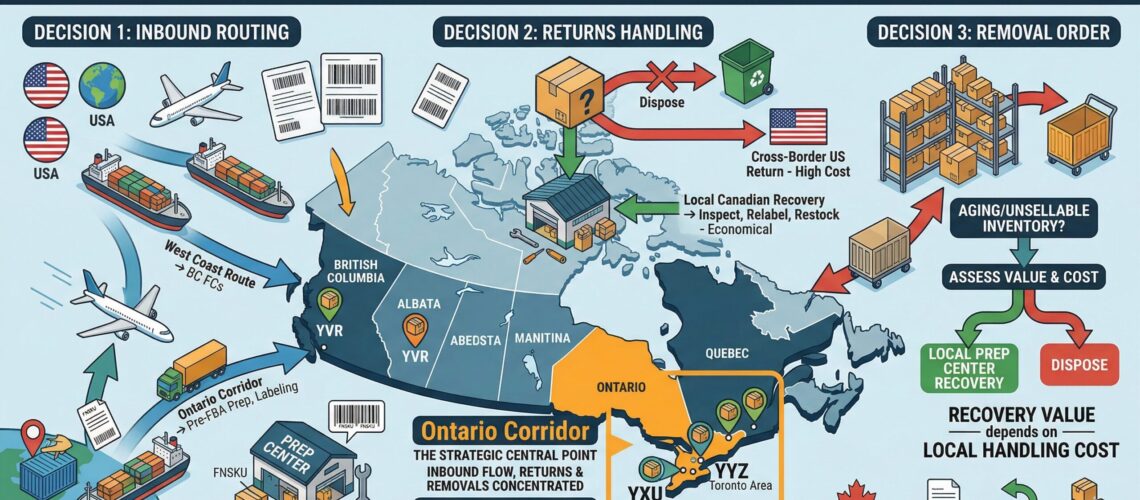
TL;DR: FC location matters because it changes three seller decisions in Canada: inbound routing, returns recovery, and removal order economics. For most Amazon.ca sellers, Ontario remains the center of gravity for both inventory flow and recovery decisions, which is why local prep, relabeling, and removal support in Southwestern Ontario matters operationally.
Why FC Location Changes Three Seller Decisions
Amazon Canada’s fulfillment network is not just a map of warehouse codes. For sellers, FC location changes three recurring operational decisions.
Inbound routing decision. When Amazon assigns your shipment to a fulfillment centre, that decision affects cross-border freight cost, receiving speed, and whether your inventory can be locally prepped before entering Amazon’s network.
Returns handling decision. When returned units cannot be restocked, FC routing affects whether recovery is practical, how expensive the return path becomes, and whether a local Canadian address changes the economics.
Removal order decision. When aging or unfulfillable inventory needs to be removed, the location of the inventory changes shipping cost, consolidation logic, and whether the inventory still has recoverable value after rework.
For sellers outside Canada, FC location is not background information. It changes the economics of all three decisions.
Decision 1 — Where Should Your Inbound Inventory Land?
Amazon does not let sellers choose the final destination FC directly, but inbound routing still matters. Inventory entering Canada through Toronto-area freight lanes will often be distributed across the Ontario corridor. Inventory entering through the West Coast is more likely to route through British Columbia first. Inventory coming by truck from the US border may move through Southwestern Ontario more efficiently than through a longer GTA routing path.
Why this matters: if units need FNSKU labeling, packaging adjustments, or inspection before entering Amazon’s network, the location of your prep workflow changes both speed and cost. Sellers who rely entirely on Amazon receiving to expose mistakes often lose time on problems that could have been corrected locally before shipment enters FBA.
If your inbound inventory needs local label correction before FBA shipment, see our FNSKU Relabeling Canada service.
Decision 2 — How Do You Handle Canadian Returns That Cannot Be Restocked?
Returned inventory in Amazon Canada is not automatically lost inventory. Many units are not unsellable because the product is defective. They are unsellable because they need inspection, sorting, relabeling, or packaging correction before they can return to sellable condition.
For most sellers, the real decision is not whether returns exist. It is whether returns can be economically recovered.
In practice, sellers usually face three options:
- dispose of the inventory
- return it to a US address
- return it to a Canadian address for inspection and recovery
For low-value units, disposal may still make sense. But when units still have resale value, a local Canadian recovery workflow often changes the economics entirely. That is especially true when sellers need to move quickly before a seasonal sales window, promotion cycle, or inventory aging threshold.
Learn more about our Amazon Returns Processing Canada service.
Decision 3 — When Is a Removal Order Actually Worth It?
Removal orders are one of the most misunderstood inventory decisions in Amazon Canada. Sellers often default to removal without fully evaluating whether the cost of shipping, handling, and rework still supports recovery value.
A removal order is usually worth considering when one of these is true:
- the inventory is aging and storage exposure is increasing
- the units need rework, such as relabeling or packaging correction
- the ASIN is still viable, but inventory is temporarily unsellable
- the seller needs a second decision point before disposal
The location of the inventory matters because it affects landed recovery cost. If inventory is concentrated in Ontario, an Ontario-based recovery point is often the most practical consolidation option. If inventory is in Western Canada, cross-country recovery may still work for higher-value units, but the economics must be judged more carefully.
Learn more about our Amazon Removal Order Processing Canada service.
Why the Ontario Corridor Matters More Than Individual FC Codes
Many sellers become too focused on individual codes such as YYZ, YXU, or YVR. The better operational question is not “Which code is this?” but “Which corridor is my inventory moving through?”
For most Amazon.ca sellers, Ontario is the most important operational corridor because that is where inbound movement, returns recovery, relabeling, and removal consolidation most often become practical. From a seller decision perspective, the corridor matters more than the warehouse code list.
That is why local execution in Southwestern Ontario is often more useful than simply knowing where an FC is located on a map.
What Changes When Inventory Routes Through Western Canada
If inventory routes through British Columbia first, the seller decision does not disappear — the economics simply change.
For low-value units, long-distance recovery from Western Canada may not make sense. For higher-value inventory, however, relabeling or recovery may still be worth it if the inventory can be consolidated and reworked efficiently.
The point is not that one corridor is always better. The point is that FC location changes the decision threshold.
Sort Centre vs Fulfillment Centre — Why Sellers Should Care
Not every Amazon code in the network represents stored inventory. Some locations are fulfillment centres, while others are sort centres.
For seller decisions, this distinction matters because:
- fulfillment centres are where inventory is stored and removed from
- sort centres are transit points, not recovery decision points
- removal and prep strategy should be based on where inventory is held, not where a package was scanned in transit
Sellers do not need to memorize every location. They need to understand which type of location affects their next operational move.
Canada FC Location — A Practical Summary for FBA Sellers
If your concern is inbound speed, the key question is whether inventory can be prepped and corrected before it reaches Amazon receiving.
If your concern is returns, the key question is whether a Canadian recovery path exists that lets inventory be inspected and restored instead of written off.
If your concern is removals, the key question is whether shipping, rework, and recovery still leave enough value to justify the process.
FC location matters because it changes those three decisions. That is what sellers should pay attention to — not just the warehouse code itself.
Related Amazon Seller Services in Canada
- Amazon Prep Center Canada — Full-service prep support for overseas sellers shipping inventory into Canada.
- FNSKU Relabeling Canada — Relabeling and inbound prep before shipment to Amazon FBA.
- Amazon Returns Processing Canada — Inspect, relabel, and recover returned inventory for resale or FBA re-entry.
- Amazon Removal Order Processing Canada — Receive and process removed inventory for recovery and re-entry.
Frequently Asked Questions
Does FC location affect Amazon Canada removal order costs?
Yes. The location of inventory affects shipping distance, consolidation logic, and whether recovery still makes economic sense after removal fees and rework costs.
Can a Canadian prep partner reduce returns recovery losses?
In many cases, yes. A local Canadian address can make inspection, relabeling, and recovery more practical than disposal or cross-border return to a US address.
Why does YXU1 matter for sellers routing through Ontario?
Because Southwestern Ontario often provides a practical location for local prep, relabeling, and recovery before inventory moves deeper into the Amazon Canada network.
Is a US return address still practical for Amazon Canada inventory?
Sometimes, but often not for low-value or rework-dependent inventory. Cross-border shipping can erase recovery value quickly.
When is a removal order worth placing instead of disposing inventory?
Usually when the inventory still has enough resale value after receiving, inspection, relabeling, and shipment costs are included.
If your inventory decisions depend on inbound prep, returns recovery, or removal order rework in Canada, see our Amazon Prep Center Canada service.