
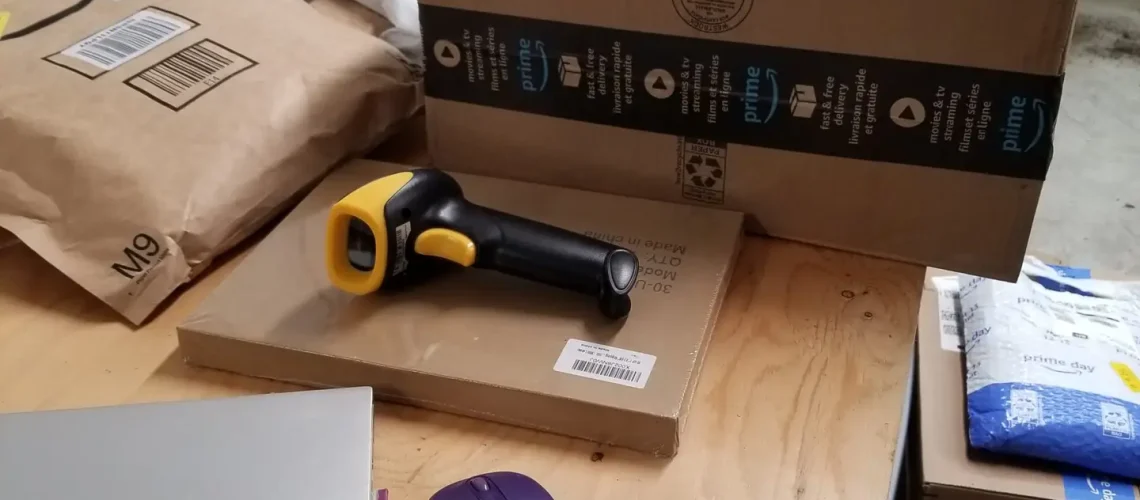
This article is written from the operational perspective of a local execution warehouse in St Thomas, Ontario, Canada.
The analysis below reflects real-world handling of FNSKU labeling, removal orders, inspection, and re-shipment workflows for resellers affected by Amazon Canada’s 2026 policy changes.
In early 2026, many Amazon sellers operating in Canada are beginning to notice something unsettling.
Accounts are still active.
Listings are still live.
Health metrics still look “acceptable.”
Yet permissions are quietly reduced, costs creep up, and recovery becomes harder with every passing month.
This is not accidental.
Amazon’s 2026 policy changes signal a structural shift:
inventory, logistics, and compliance are no longer operational details — they are account-level risk factors.
For sellers affected by Amazon Canada’s 2026 labeling and inventory policy changes,
execution is no longer optional.
MoRo Prep operates a physical execution warehouse in St. Thomas, Ontario,
supporting FNSKU relabeling, removal order inspection, and compliant re-shipment
for YXU1, YYZ / YYC fulfillment networks.
This article does not interpret policies line by line. The conclusions are drawn from inventory decisions observed through actual execution cases handled in St Thomas, Ontario, Canada.
Instead, it explains what has fundamentally changed, and why inventory decisions will increasingly determine whether a seller can operate sustainably.
For sellers evaluating next-step execution under the 2026 policy shift, a cost-based operational decision framework is outlined here.
1. Inventory Has Shifted from Cost Center to Risk Center
Historically, inventory management on Amazon was treated as a cost optimization problem:
- Reduce storage fees
- Improve sell-through
- Manage cash flow
In 2026, that model is no longer sufficient.
With new aging inventory surcharges, stricter automation, and reduced tolerance for inefficiency, inventory now directly affects:
- Account trust signals
- System permissions
- Long-term operational flexibility
The question is no longer “Can this product sell eventually?”
It is “Is this inventory worth occupying system resources today?”
2. The End of FBA Prep Services Moves Risk Upstream
As of January 1, 2026, Amazon US officially discontinued FBA prep and labeling services.
This change does more than increase operational workload.
It moves failure risk forward in the supply chain.
This shift makes third-party execution—such as labeling, inspection, and removal handling—an operational necessity rather than an optional service.
Previously:
- Labeling issues often resulted in unplanned service fees or delays
Now:
- Non-compliant inbound shipments are more likely to be rejected or returned
- Costs are unpredictable
- Accountability sits entirely with the seller
For sellers without reliable upstream execution — whether in-house or via third-party partners — inbound logistics becomes a single-point failure.
3. Aging Inventory Fees Are Designed to Force Decisions
Aging inventory surcharges have existed for years, but in 2026 they are no longer symbolic.
For inventory exceeding defined age thresholds, fees can reach multiples of standard storage costs — in some cases more than ten times higher.
This design is intentional.
Amazon is signaling that:
- Indecision is a decision
- Delayed action is a cost choice
- “Waiting it out” is no longer neutral
Inventory is now evaluated over time, not at a single moment.
Every additional day becomes part of the risk calculation.
4. Inventory Decisions Are No Longer Binary
When inventory performance deteriorates, sellers typically consider three options:
- Keep inventory in FBA and wait
- Dispose of inventory
- Remove and rework inventory externally
In practice, a fourth option increasingly matters:
- Liquidate at reduced price to recover partial value
Each path reflects a different risk posture.
The challenge is not operational complexity — it is decision timing.
In 2026, sellers who delay decisive action often incur the highest cumulative losses, even if the product eventually sells.
5. Why Inventory Problems Tend to Compound
Many sellers struggle with inventory not because they lack data, but because they avoid final judgments.
Common patterns include:
- Holding unsellable inventory “just in case”
- Postponing removal decisions month after month
- Waiting for demand recovery without adjusting cost structure
Under current fee structures, hesitation compounds losses.
Inventory is no longer a static asset.
It is a continuously depreciating position inside a system optimized for efficiency.
6. What Amazon Is Quietly Optimizing For
Amazon’s 2026 direction is less about enforcement, and more about filtering sellers by operational predictability. Amazon’s 2026 direction is not about removing sellers.
It is about filtering for operational profiles.
The system increasingly favors sellers who:
- Make timely inventory decisions
- Maintain predictable logistics execution
- Operate within explainable, stable structures
Sellers are not eliminated through dramatic enforcement events —
they are constrained gradually through cost pressure and reduced flexibility.
At this stage, inventory strategy is no longer about optimization.
Sellers are being forced to decide where execution happens, how fast decisions are made, and how much uncertainty they are willing to absorb.
The following sections explore why those execution choices increasingly define survival outcomes.
Final Thought
Most inventory will sell eventually — if demand exists.
But profitability is no longer determined by sales alone.
It is determined by where inventory waits, for how long, and at what systemic cost.
In 2026, inventory strategy is no longer an operational detail.
It is a survival decision.
For sellers operating in North America, especially Canada, local execution and inventory structure will increasingly determine long-term viability.